Best Thermal Scopes for Coyote Hunting: Top Picks
Finding the right thermal scope for coyote hunting depends on range, target speed, and field conditions. This guide highlights five practical options, each suited for different hunting styles—from fast-moving setups in brush to long-range night stalks. Best for close- to mid-range tracking, and durable builds for late-night hunts, these selections help you balance reliability, power, and cost. Read on to compare who each scope is best for and why it stands out for coyotes.
Quick reference:
- AGM Global Vision Rattler V2 19-256 — Best for fast targets, compact light-weight setups.
- AGM Global Vision Rattler V2 25-256 — Best for longer-range detection and extended hunts.
- RIX Storm S2 — Best for high sensitivity and balanced long-range performance.
- TOPDON TS004 Monocular — Best for versatile monocular use and app connectivity.
- GOYOJO GRS225-RF — Best for integrated rangefinding and ballistic assistance.
AGM Global Vision Rattler V2 19-256 Thermal Scope

The Rattler V2 19-256 offers a 2.5x base magnification and a wide field of view, ideal for quick scanning in brush and dense terrain. It supports up to 11.5 hours on a single charge and ships with two rechargeable batteries for extended outings. Ten reticle styles and eightfold digital zoom aid in distance estimation and precise shots. Best for: hikers and sneaky stalkers who need rapid target acquisition in close quarters. Caution: the compact base magnification may limit long-range identification in open terrain.
AGM Global Vision Rattler V2 25-256 Thermal Rifle Scope

This version raises base magnification to 3.5x and uses a 25mm Germanium lens, extending detectable heat signatures to around 1,250 yards. It comes with a removable power system and similar battery life for extended hunts. Ten reticle options, digital zoom up to 8x, and the stadiametric rangefinder support long-range shots. Best for: bowing coyotes at mid-to-long range or navigating low-visibility nights. Caution: higher magnification can reduce situational awareness in thick cover.
RIX Storm S2 Thermal Rifle Scope

The RIX Storm S2 uses a 256×192 sensor with a 3.5x base magnification and a 7.0° horizontal field of view, enabling clear target detection to about 1,422 yards. It features image enhancement through RET technology to improve image clarity. Best for: long-range coyotes and wide-open terrain where detection range matters. Caution: high-sensitivity modes may require some adaptation to avoid false positives in yard-scale hunting environments.
TOPDON TS004 Thermal Monocular

TOPDON TS004 combines a 256×192 IR resolution with a 50Hz refresh rate for vivid, lag-free visuals. The 11-hour battery and IP67 rating support rugged nighttime hunts. It offers wireless connectivity with a dedicated app for live monitoring and media capture. Best for: scouting and quick-target confirmation in challenging terrain. Caution: as a monocular, it lacks a built-in rifle mount option for steady firing from a rifle platform.
GOYOJO GRS225-RF Thermal Rifle Scope
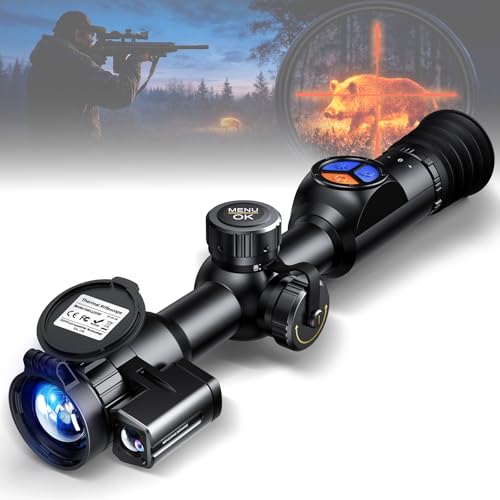
The GRS225-RF pairs a 256×192 sensor with a 25mm objective lens and a 1x–8x zoom, delivering long-range heat detection up to 1,224 yards. It includes integrated rangefinding and ballistic assistance for holdover calculations. Best for: coyotes at distance or hogs in brush where precise adjustments are critical. Caution: 50Hz operation requires careful attention to start-up timing in very fast encounters.
Buying Guide
- Detection Range: Choose a scope with a detection range matching your typical hunting terrain; longer-range models help in open fields, shorter-range models excel in dense brush.
- Magnification and Field of View: Higher base magnification aids distant shots but reduces situational awareness in thick cover; balance with field of view for target acquisition.
- Battery Life: Look for scopes with multi-hour runtimes and swappable batteries for extended outings.
- Image Quality: NETD (noise) and sensor resolution affect clarity in twilight or fog; higher values reduce necessary adjustments at distance.
- Reticles and Rangefinding: Multiple reticle styles and built-in rangefinders speed up distance estimation and holdover.
- Durability and Weather Resistance: IP ratings and rugged construction matter for field conditions and rain exposure.
Frequently Asked Questions
- What is NETD and why does it matter for coyotes? NETD measures thermal image noise; lower NETD means clearer images at distance, which helps identify coyotes in low-contrast environments.
- Is a higher magnification always better? Not always. Higher magnification can reduce situational awareness in brush; choose based on typical hunting scenarios.
- How important is battery life for night hunts? Very important. Longer runtimes reduce the risk of losing power during long sits or late-night tracking.
- Should I prioritize built-in rangefinding? If you frequently shoot at distance, a built-in rangefinder and ballistic assistance improve holdover accuracy.
- Do I need waterproofing? Yes, IP67 or higher is advisable for rugged field use and unpredictable weather conditions.
- Are monoculars enough for hunting? Monoculars work for scouting and confirmation but may require separate mounting for rifle use; consider your preferred setup.