Best 100 Amp MPPT Charge Controllers for Off-Grid Power
This guide highlights top 100A MPPT solar charge controllers suited for 12V to 48V battery systems. Each product prioritizes efficient energy harvesting, battery protection, and versatile battery compatibility. The selection focuses on models with strong MPPT performance, multi-voltage operation, and robust protections to keep solar setups reliable in off-grid homes, RVs, boats, and remote cabins.
| Product | Brand | Key Benefit |
|---|---|---|
| POWLAND 100A MPPT Solar Charge Controller | POWLAND | High efficiency MPPT with 4-stage charging and wide voltage compatibility |
| Renogy 100A MPPT Solar Charge Controller | Renogy | Advanced charging tech with auto-detection and protective features |
| HQST 100A MPPT Solar Charge Controller | HQST | Bluetooth monitoring and high efficiency for LiFePO4 and other chemistries |
| PowMr 100A MPPT Solar Charge Controller | PowMr | Parallel expansion capability and multi-stage charging |
| Temank 100A MPPT Solar Charge Controller | Temank | High parallel capacity with dual cooling and broad battery compatibility |
Note: The table above lists five representative models from the broader 100A MPPT market. Each entry is selected for real-world versatility and robust MPPT performance across 12V, 24V, 36V, and 48V systems.
POWLAND 100A MPPT Solar Charge Controller

The POWLAND 100A MPPT Solar Charge Controller supports 12V/24V/36V/48V battery systems with an input up to 150V. It employs a four-stage charging algorithm—bulk, boost, float, and equalizing—to optimize charging speed while protecting battery health. Real-time MPPT tracking aims to maximize solar energy capture, achieving high utilization and efficiency. It includes protective features such as short circuit, open circuit, reverse, and overload protection to safeguard connected batteries and panels. The device is designed for flexible installations, including solar RVs and household solar systems.
Renogy 100A 12V/24V/36V/48V DC Input MPPT Solar Charge Controller

Renogy’s 100A MPPT controller maximizes energy harvest with an MPPT efficiency around 99.9% and supports multiple battery chemistries, including lead-acid, AGM, gel, flooded, and Li-ion types. It automatically detects 12V/24V/36V/48V systems to simplify setup and includes protective features to prevent reverse polarity, short circuits, and overloading. The controller is designed for harsh environments with an IP32 rating and temperature compensation. It’s well-suited for RVs, marine applications, and off-grid homes seeking reliable, long-term performance.
HQST 100A MPPT Solar Charge Controller
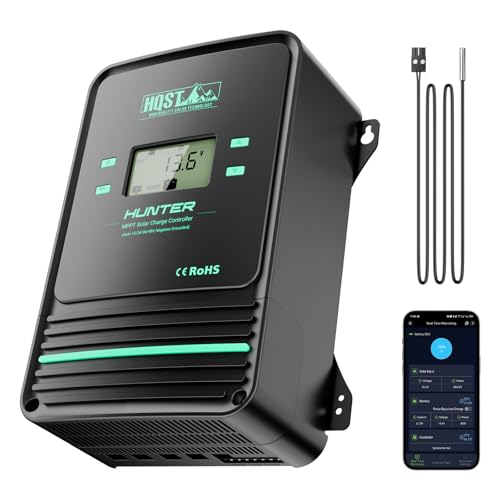
HQST offers a 100A MPPT controller with built-in Bluetooth for remote monitoring via smartphone apps and an LCD display for on-device visibility. It supports LiFePO4 batteries with low-temperature cut-off protection to prevent damage in cold starts, and it is compatible with LiFePO4, sealed, AGM, gel, flooded, and other battery types. Its MPPT stage yields high tracking efficiency (up to 99% in some conditions) and strong efficiency gains over PWM controllers. The unit suits off-grid systems, RVs, and boats where monitoring flexibility matters.
PowMr 100A MPPT Solar Charge Controller

PowMr’s 100A MPPT controller is designed for 12V/24V/36V/48V systems and supports parallel operation up to 12 units, enabling scalable solar configurations. It features a three-stage charging algorithm (bulk, boost, float) to optimize battery life and charging efficiency. The unit uses innovative MPPT tracking to reach efficiencies near 99% and high peak conversion efficiency. It accepts multiple battery chemistries, including lead-acid and LiFePO4, with pre-set charging parameters and user customization options.
Temank 100A MPPT Solar Charge Controller

Temank’s 100A MPPT controller supports up to 12 parallel units to increase total system capacity, offering a scalable solution for large solar installations. It uses a dual cooling system with a turbofan to manage heat and maintain performance in demanding environments like RVs, commercial vehicles, and boats. The device is compatible with a broad range of batteries, including lead-acid and lithium types, with customizable charging parameters such as absorption and float voltages, low-voltage cutoff, and load control timing.
Buying Guide: Key Purchase Considerations
When selecting a 100A MPPT charge controller, consider the following factors to match your system needs:
- Voltage and battery compatibility: Ensure the controller supports your battery bank voltage (12V, 24V, 36V, or 48V) and chemistries (lead-acid, LiFePO4, lithium-ion, etc.).
- MPPT tracking efficiency: Higher MPPT efficiency translates to more energy harvested in partially shaded or variable conditions. Look for advertised tracking efficiency near 99% or higher and peak conversion efficiency in the 97–99% range.
- System expansion: If you plan to scale your solar array, check parallel-capable models and the maximum number of units you can connect (e.g., up to 12 units in parallel).
- Protection features: Essential protections include short-circuit, reverse polarity, overcurrent, overvoltage, over-temperature, and load disconnect protections to safeguard batteries and panels.
- Monitoring and control: LCD displays, Bluetooth apps, or mobile monitoring options help track performance, voltage, current, and battery state of charge in real time.
- Temperature management: Heatsinking and cooling mechanisms reduce thermal throttling, especially in high-load, enclosed spaces like RVs and boats.
- Installation and wiring: Confirm supported input voltage range, wire gauge recommendations, and mounting options to fit your installation environment.
- Warranty and support: Longer warranty and responsive customer support can reduce long-term maintenance risk in off-grid setups.
Comparing these five models, buyers should weigh MPPT efficiency, battery compatibility, expansion potential, and monitoring features against the installation environment—whether a mobile RV, a small off-grid cabin, or a larger solar array for a workshop.