Best Depth Finders for Kayaks: Clear Water Readings for Anglers on the Move
Finding the right depth finder for a kayak depends on how you fish, where you paddle, and how you use sonar data on the water. This guide highlights five portable, kayak-friendly depth finders that balance usability with useful fish and structure readings. Best for compact setups, casual day trips, or serious angling, these picks help you identify underwater features, depths, and fish inshore and offshore. Each option targets different needs—from built-in GPS and CHIRP imaging to handheld portability and wireless convenience.
Buyer preferences at a glance:
| Product | Key Strength | Best For | Limitations |
|---|---|---|---|
| Garmin Striker Vivid 4cv | Color CHIRP imaging, built-in GPS | Kayak anglers needing GPS marks and imaging | 4-inch display may feel small for some users |
| Humminbird PiranhaMAX 4 DI | Down Imaging and Dual Beam | Clear sonar imagery of structure | Smaller display, basic features |
| Garmin Striker 4 | CHIRP traditional sonar, GPS | Simple, reliable setup | Limited screen size options |
| Lowrance Eagle 4X | IPS daylight view, true-scroll sonar | Clear, readable screen in bright conditions | Basic feature set |
| LUCKY Kayak Portable (MT-202) | Wireless handheld with long-range sonar | Extremely portable, wireless use | Limited depth range and features |
Garmin Striker Vivid 4cv Fishfinder

Best for kayakers who want built-in GPS and vivid color imaging. The 4-inch color display uses Vivid scanning sonar palettes to distinguish fish and structure, aiding quick decisions on the water. It includes a GT20 transducer with CHIRP traditional sonar and CHIRP ClearVü scanning sonar, and a high-sensitivity GPS to mark waypoints, build routes, and view speed. This makes it suitable for anglers who navigate to known spots and prefer a compact, easy-to-read unit. Caution: the screen size may be smaller for split-screen multitasking.
Yoocylii Handheld Fish Finder

Best for portability and quick deployment. This handheld unit is designed for kayak use, docks, or ice fishing, and displays water depth, approximate fish location, and bottom details. It runs on 4 AAA batteries and provides 4–5 hours of continuous use, with a 200 kHz sonar frequency and a 45-degree beam. Choose this if you need a lightweight, handheld option that you can wear around your neck while paddling. Limitation: battery life is finite and battery type is not rechargeable in-unit without replacement.
Humminbird PiranhaMAX 4

Best for anglers who want a dual-beam experience with straightforward operation. The PiranhaMAX 4 offers dual beam sonar for detail (narrow) or coverage (wide) along with tilt and swivel mounting for flexible viewing angles. It includes a 1-year warranty in the product listing. Best for: kayaks where you need a simple interface and solid structure detection. Caution: imaging depth and detail can be limited compared to higher-end DI models.
Garmin Striker 4 with Transducer

Best for a compact, entry-level GPS fishfinder. The Striker 4 uses CHIRP traditional sonar and a ClearVü imaging option on compatible transducers, with an easy-to-use interface and waypoint mapping. It is well-suited for kayaks that require a straightforward setup and dependable sonar. Limitation: display size may constrain detailed viewing in rough chop or when scanning large areas.
Lowrance Eagle 4X

Best for daylight readability and simple operation in tight kayak setups. The Eagle 4X features a high-vis IPS screen for crisp viewing in bright conditions and durable tide-ready construction. It offers a reliable twist-lock connector for easy installation and true-scroll sonar for structured readability. Caution: more basic features compared to premium models, which may limit deep-water capabilities.
LUCKY Kayak Portable (MT-202)
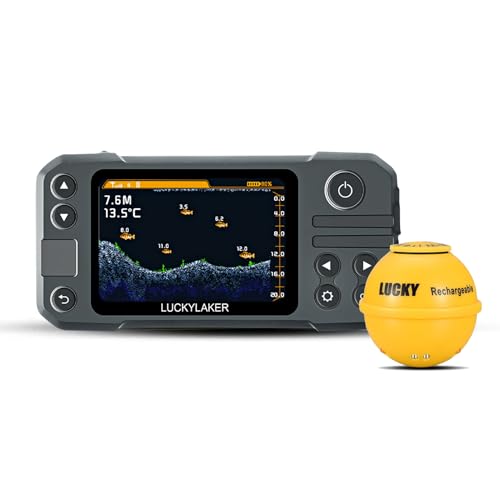
Best for wireless, castable versatility. The LUCKY MT-202 provides wireless control with a long sonar range and a compact 3.5-inch display. It shows fish depth, location relative to structure, and bottom details, with a 90-degree beam and 3–147 feet depth capability. Choose this if you want a wireless solution that you can move between boats or shore. Limitation: wireless units may have occasional connectivity quirks in rough water.
Buying Guide: How To Choose The Right Kayak Depth Finder
What type of sonar do you need?
Traditional CHIRP sonar offers clear targets and structure detail. CHIRP ClearVü provides enhanced scanning images, while Down Imaging shows bottom details for a more realistic view. For beginners, a combination unit with GPS adds waypoint functionality for finding productive spots.
Display size and readability
Smaller displays save space on a kayak but can strain readability in bright sun or rough water. If you fish in daylight or wear polarized sunglasses, a higher-contrast IPS or color display improves visibility. Consider a model with adjustable backlight for dawn or dusk outings.
Portability and mounting
All listed options cater to kayak use, but some are handheld or easily transferable between vessels. If you want a permanent mount, check for tilt/swivel mounting options and quick-release brackets. For portable trips, handheld devices save setup time.
Power and runtime
Wired units rely on boat power, while handhelds use batteries. For extended trips, verify battery type, expected life, and charging options. If you paddle long distances, ensure the device can operate for several hours without frequent replacements.
Additional features to consider
GPS waypoint marking is valuable for returning to productive spots. Dual-beam sonar broadens coverage versus target detail. Down Imaging and DI/VI imaging modes help with seabed and structure identification. Waterproofing and IP ratings improve reliability in wet kayaking conditions.
Summary: Quick recommendations
- Best overall imaging and GPS: Garmin Striker Vivid 4cv
- Best handheld portability: Yoocylii Handheld Fish Finder
- Best value with dual imaging: Humminbird PiranhaMAX 4 DI
- Best simple GPS fishfinder: Garmin Striker 4
- Best daylight readability: Lowrance Eagle 4X
- Best wireless mobility: LUCKY MT-202
Frequently Asked Questions
- Do kayak depth finders work in saltwater?
- Is a GPS feature essential on a kayak depth finder?
- Which sonar type is easiest for beginners?
- Can I upgrade a kayak depth finder later?
- What is the typical mounting requirement for a kayak depth finder?
Yes. Many models are designed for both freshwater and saltwater use, but confirm the transducer and hull compatibility for corrosive environments.
Not essential, but GPS adds significant value for marking productive spots and navigating routes, especially on larger lakes or coastlines.
CHIRP traditional sonar with a basic display is typically easiest to learn, while dual-beam options add coverage and detail as you gain experience.
Yes. Many units support add-on transducers or replacement modules, making future upgrades feasible without full reinstallation.
Most units use a simple mount with a bail or bracket. Verify your kayak’s deck material and available rail space, and ensure the bracket supports the display size.