Best Kid-Friendly Earphones for Safe Listening and Fun
Choosing the right earphones for kids involves balancing volume safety, durability, comfort, and compatibility with common devices. This guide highlights five reliable options designed for children and tweens, featuring volume limits, sturdy builds, and kid-friendly designs. Each product section includes an overview, key features, and how it fits different use cases such as school, travel, and online learning.
Quick comparison
| Product | Brand | Key Benefit | Volume Safety | Wired/Wireless |
|---|---|---|---|---|
| JBL Junior 320 | JBL | Built-in mic, safe listening | Yes (<85dB) | Wired |
| iClever HS19 | iClever | Safe volume control, sharing jack | Yes (85dB) | Wired |
| Belkin SoundForm Mini | Belkin | Long battery life, 85dB limiter | Yes (85dB) | Wireless |
| iClever Cat Ear | iClever | Fun design, USB-C, Bluetooth option | Yes (volume limiter) | Wireless + Wired |
| Mehomeli Open-Ear | Mehomeli | Open-ear design for situational awareness | Yes | Wired |
JBL Junior 320 – Safe Sound

The JBL Junior 320 is designed to protect young listeners by keeping sound exposure below 85 decibels. This on-ear headset includes a built-in microphone for classroom discussions and online learning, making it suitable for home schooling and school activities. The compact, adjustable frame fits kids comfortably, with a reliable wired connection to ensure stable audio during long listening sessions without the need for pairing or charging.
Key features include a fixed safe listening cap, a durable build for daily use, and compatibility with common devices via a standard 3.5 mm jack. Parents and teachers can appreciate the straightforward wired design that minimizes setup hurdles for younger students. Its on-ear design offers a balance between sound fidelity and comfort for school-day wear.
iClever HS19 Kids Headphones
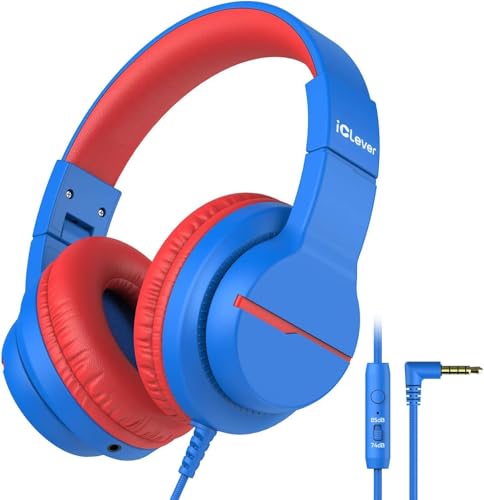
The iClever HS19 headphones are tailored for school use, featuring a safe volume limit (up to 85dBA) to protect young ears. They come with a built-in microphone for online classes and easy compatibility with devices that have a 3.5 mm audio jack, including Chromebooks, Kindle Fire tablets, and laptops. The headphones support stereo sound with a share port, letting peers listen together without extra adapters, which is ideal for collaborative learning or family entertainment.
Designed for comfort, the lightweight frame and padded cushions help young listeners wear them during long sessions. The shared listening capability makes pair-based activities simple, and the sturdy construction withstands daily handling by kids. For parents seeking a practical, education-focused option, these fit many classroom and remote-learning scenarios.
Belkin SoundForm Mini – Wireless Kids Headphones

The Belkin SoundForm Mini provides wireless listening with up to 30 hours of battery life and Bluetooth 5.3 connectivity, making it suitable for travel and daily use. A built-in microphone supports calls and classroom discussions, while the 85dB volume limiter protects young ears. The USB-C fast charging capability provides quick power boosts, helping to minimize downtime between learning and play. This model is designed for iPhone, iPad, Android devices, and other Bluetooth-enabled gadgets.
Parents will appreciate the kid-friendly safety features, including a dedicated volume cap and durable construction. The wireless design reduces cable clutter on desks and in backpacks, and a compact form factor makes it easy for kids to carry on field trips or commutes.
Mehomeli Open-Ear Kids Headphones

Mehomeli’s open-ear design uses Air Conduction Technology to deliver sound without fully covering the ears. This approach enhances situational awareness, which can be safer for school and outdoor use. The lightweight build and ergonomic design keep comfort high during extended wear, and the design works well with glasses or helmets. The wired 3.5 mm connection ensures compatibility with many devices used in classrooms and at home, offering stable audio without requiring Bluetooth pairing.
The open-ear approach also supports parents who want children to stay alert to their environment, whether walking to class or commuting. The 16.2 mm drivers provide balanced sound suitable for learning, music, and videos, while the compact construction makes them easy to pack for trips or school days.
Buying Guide: Key Purchase Considerations
- Volume safety: Look for headphones with a built-in volume limiter (commonly 85 dB), especially for younger children. This helps reduce long-term hearing risk during daily use and online learning.
- Durability: Kids’ headphones should resist rough handling. Consider models with reinforced cables, tangle-free cords, and sturdy hinges or headbands designed for kids.
- Comfort and fit: A lightweight design with soft padding and an adjustable headband improves wearability throughout classroom, travel, and gaming sessions.
- Wired vs. wireless: Wired headphones avoid charging needs and Bluetooth latency, while wireless models offer more freedom of movement. Some models combine both wired and wireless modes for versatility.
- Microphone and compatibility: If online schooling or calls are frequent, a built-in microphone is useful. Check compatibility with common devices (iPad, Chromebooks, tablets, laptops) and 3.5 mm jacks.
- Sharing features: Some models provide a sharing jack, allowing two or more kids to listen together without extra adapters, ideal for family use or classroom activities.
- Open-ear vs. closed-back: Open-ear designs can improve situational awareness and comfort in long sessions, while closed-back headphones often offer stronger noise isolation for travel or noisy environments.
- Maintenance: Removable, washable parts or easily replaceable cushions extend the life of kids’ headphones and simplify cleaning after everyday use.
When selecting for a specific setting—classroom use, travel, or home learning—prioritize the combination of safety features, durability, and comfort that best aligns with your child’s age and activities. For environments with potential background noise, consider models with open-ear design for awareness or noise-attenuating features in closed-back designs. If frequent charging is a concern, wireless options with long battery life and quick charging can reduce downtime between study sessions and playtime.