Best Electronic Speed Controllers for Brushless Motors: Top 5 Picks for RC Projects
Finding the right electronic speed controller (ESC) is essential for precise, reliable brushless motor control in RC drones, airplanes, boats, and robotics. This guide highlights five well-rounded ESC options, each suited to different project needs. Best for hobbyists prioritizing high continuous current, ultra-lightweight builds, or easy integration with common receivers and flight controllers. The buyer’s table below compares core specs at a glance.
| Product | Continuous Current | Voltage Range | BEC Output | |
|---|---|---|---|---|
| Nuofany 40A ESC | 40A | 2-4S LiPo | 5V @ 3A | Mid-size drones and multi-rotors needing solid current headroom |
| HAWK’S WORK 20A ESC | 20A | LIPo (XT60) connection | 5V @ 1A | Ultra-lightweight setups where weight savings matter |
| RioRand 350W 3-Phase PWM ESC | 20A peak (350W) | 6-60V input | 0-5V analog/PWM control | DIY robotics and small tools with Hall-sensor motors |
| DYS 12A 2-4S ESC | 12A | 2-4S LiPo | 5V @ 2A | Fixed-wing and mini RC projects needing compact ESC |
| Acxico 30A Brushless ESC | 30A continuous | 8-24V input | Not specified | High-power brushed and brushless setups with safety features |
Nuofany 40A Brushless ESC 2-4S

The Nuofany 40A ESC provides a robust continuous current of 40A with a 55A short-time rating. It operates on 2-4S LiPo packs and includes a 5V/3A BEC. This model is best for mid-sized drones, airplanes, or multi-rotors needing dependable current handling without adding excessive weight. The built-in BEC supports powering a receiver or flight control system directly from the ESC.
Best for: hobbyists building medium-sized RC aircraft or drones that require a reliable 2-4S ESC with an integrated BEC. It is a strong choice when you need straightforward integration with flight controllers that accept a 5V BEC supply.
Limitations: The BEC is linear, which may dissipate more heat under heavy throttle; ensure adequate cooling and avoid prolonged high-load flights. Use with compatible motors that stay within the 2-4S voltage window to prevent overcurrent scenarios.
HAWK’S WORK 20A Brushless ESC

The HAWK’S WORK ESC is designed for ultra-lightweight systems, delivering 20A capacity with a 5V/1A BEC. It ships with XT60 and 3.5mm plugs, making it easy to pair with smaller quads, micro drones, or FPV airframes where weight is critical. The compact form factor helps reduce dead weight while maintaining reliable speed control.
Best for: tiny or micro aerial platforms where every gram counts and a small, efficient ESC improves responsiveness and flight time.
Limitations: Lower continuous current means this ESC is not suitable for larger motors or high-thrust builds. Ensure motor selection aligns with the 20A rating to avoid overheating.
GODIYMODULES DC 7-24V 200W ESC

This 200W, 7-24V Hallless driver supports a three-phase brushless motor setup with a potentiometer-based speed control, maximums around 224,000 RPM for 2-pole configurations. It suits DIY projects requiring robust speed control with a configurable interface, including forward/reverse and brake functions. External protections and wiring recommendations are noted for safe operation.
Best for: builders needing a compact, adjustable ESC for Hallless BLDC motors in hobby robotics or small CNC-like setups.
Limitations: The device relies on hard commutation for some features, so proper throttle management is essential to prolong component life. Verify motor pole count and wiring compatibility before use.
CDMALL AC Motor Speed Controller (Brushed)
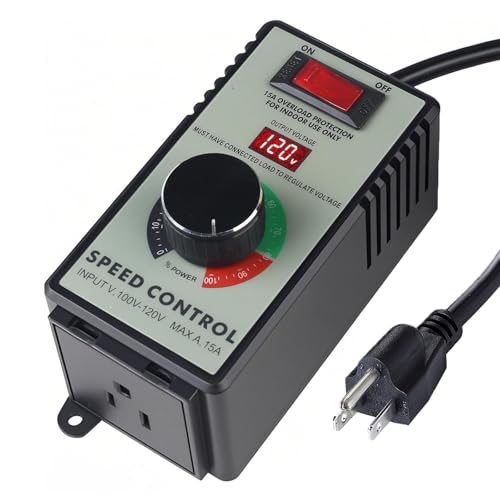
CDMALL’s brushed AC motor speed controller is designed for AC motors rather than DC or brushless systems. It features a real-time LED voltage display and a built-in overload protection with a resettable 15A circuit breaker. It’s suitable for inline duct fans, exhaust fans, ceiling fans, routers, and other AC-powered devices where precise, safe speed control is needed.
Best for: projects using AC brushed motors, where a dial-based speed adjustment and real-time voltage readout help dial in performance. Not suitable for brushless or DC motors.
Limitations: Not compatible with brushless DC motors or devices with integrated control boards. Verify motor type to avoid mismatches and inefficiencies.
Acxico DC12V 30A Brushless ESC

The Acxico speed controller supports high-speed, high-power brushless motors with a 12V input and 30A continuous capacity. It emphasizes safety startup and temperature protection, with an aluminum heatsink to aid cooling. Designed to protect both the ESC and motor during prolonged operation, it’s well-suited for larger or fast-spinning BLDC setups.
Best for: medium-to-high-performance BLDC projects requiring solid thermal management and a robust startup sequence. Choose this if heat buildup is a concern and you need extra protection features.
Limitations: Temperature-based power reduction is automatic; ensure adequate airflow and heat dissipation during long sessions to prevent unintended power cuts.
Buying Guide: Choosing The Right ESC
- Motor and battery compatibility: Match the ESC’s continuous current rating to your motor’s current draw and ensure the voltage range supports your LiPo or LiPo-like battery. Overload can shorten ESC life or damage motors.
- BEC needs: If you power receivers or flight controllers from the ESC, confirm the BEC voltage and current (5V, 1A–3A) suit your electronics. Consider external BECs if higher current is required.
- Control interface: Decide between PWM, analog 0-5V, or digital signals. Some ESCs offer hall-sensor compatibility or forward/reverse modes—plan around your flight controller’s inputs.
- Heat management: Larger continuous-current ESCs benefit from ample cooling. Look for heat sinks, fan support, or lightweight designs if payload matters.
- Protection features: Overcurrent, overtemperature, and polarity protection extend life. External fuses or circuit breakers can add safety in larger builds.
- Mounting and wiring: Check connector types (XT60, XT30, 3.5mm plugs) and whether pre-soldered leads match your airframe setup. Plan wire routing to minimize signal interference.
- Application suitability: ESCs labeled for “brushless” with three-phase motor support are intended for BLDC setups. Brushed controllers suit DC or AC devices, not brushless motors.
- Ease of integration: If you’re a beginner, choose ESCs with straightforward wiring, clear documentation, and compatible BEC specs to avoid complex troubleshooting.
FAQ
- What is an electronic speed controller (ESC)?
- Do I need a high-current ESC for a large drone?
- Can an ESC power a flight controller directly?
- What is a BEC and why is it important?
- What should I consider about ESC heat?
- Can I mix ESC brands with any motor?
An ESC regulates the speed and direction of a brushless motor by controlling the motor’s voltage and current via electronic switching. It often includes a BEC to power receivers and controllers.
Yes. Larger drones with powerful motors require higher continuous current ratings to prevent overheating and ensure stable flight.
Many ESCs include a BEC to supply 5V to a flight controller or receiver. Check the BEC amperage to ensure it meets the controller’s power requirements.
A BEC (battery eliminator circuit) provides a regulated voltage (commonly 5V) from the main battery to power electronics. It reduces the need for separate power supplies on small builds.
ESCs generate heat under load. Ensure adequate airflow or heat sinking, and select a model with a current rating that exceeds your motor’s peak draw to prevent thermal throttling.
Not always. Ensure the ESC’s current rating, voltage range, and wiring are compatible with your motor’s specifications, physical size, and the airframe’s layout.