Best Ethernet Cables for Phone Use: Fast, Reliable, and Easy to Install
Answering the question, these Ethernet cables and adapters provide dependable wired connections for phones, tablets, and laptops that support wired networking. They’re ideal for improving stability during video calls, gaming, or large file transfers when Wi‑Fi isn’t enough. This guide highlights five top options, noting who each is best for and why. Use the buying guide to compare lengths, speeds, shielding, and compatibility before you buy.
| Product | Best For | Key Benefit |
|---|---|---|
| Amazon Basics RJ45 Cat 6 Ethernet Patch Cable – 15 ft | General home or small office users | Reliable Cat6 performance with snagless connectors |
| Cable Matters 10Gbps Cat 6 – 20 ft | Power users needing future-proof, fast LAN | Cat6 with 10-Gigabit readiness at a budget price |
| DbillionDa Cat 8 Ethernet Cable – 6 ft | Low-latency gaming and high-bandwidth tasks | Cat8 with 40 Gbps speeds and heavy shielding |
| Cable Matters 10Gbps Cat 6 – 25 ft | Longer runs in home networks | Cat6 with ample length and solid performance |
| Jadaol Cat 6 Flat Ethernet Cable – 50 ft | Large spaces or temporary setups | Flat design for easy routing and long reach |
Amazon Basics RJ45 Cat 6 Ethernet Patch Cable

Brand: Amazon Basics. Features include Cat-6 UTP copper conductors, RJ45 connectors, 250 MHz bandwidth, and speeds up to 10 Gbps. This cable is best for general home and office devices such as computers, printers, and routers. The snagless design helps protect the connector during cable routing. Best for buyers who want a straightforward, affordable Cat6 solution for standard wired networking. Caution: not ideal for environments requiring shielded or extreme high-frequency performance.
Cable Matters 10Gbps Snagless Cat 6 Ethernet Cable – 20ft
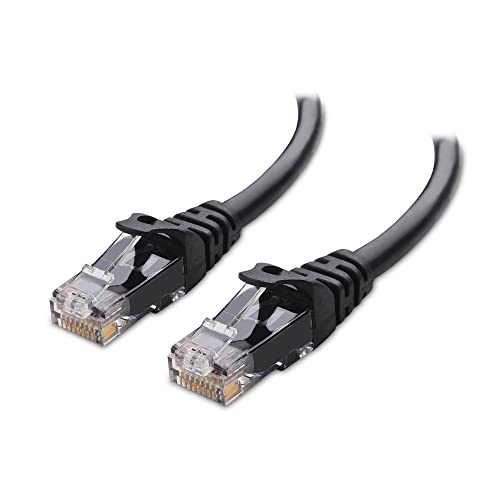
Brand: Cable Matters. Features include 24 AWG copper, universal LAN connectivity, Cat6 performance with future 10-Gigabit readiness, and compliance with TIA/EIA 568-C.2. Best for users needing reliable wired connections for PCs, routers, printers, or servers with longer cable runs. Choose this if you want a balance of cost, performance, and length. Caution: Cat6 performance may not meet top-tier Cat7/Cat8 demands in ultra-high traffic setups.
DbillionDa Cat 8 Ethernet Cable – 6 ft

Brand: DbillionDa. Features include Cat8 with up to 40 Gbps, 2000 MHz bandwidth, heavy shielding, and weatherproof outdoor/indoor design. Best for low-latency gaming, 4K/8K streaming, and high-speed internet needs where shielding and stability are critical. Better for users who demand maximum performance and can accommodate short lengths. Caution: Cat8 cables are thicker and stiffer, which can affect routing in tight spaces.
Cable Matters 10Gbps Snagless Cat 6 Ethernet Cable – 25ft
Brand: Cable Matters. This 25-foot Cat6 cable offers universal connectivity for LAN components, 24 AWG copper, and Cat6 performance ready for 10-Gigabit Ethernet. Best for longer home networks where a reliable, cost-efficient wired link is needed. Caution: As with longer Cat6 runs, you may see some latency or signal loss if the environment has high electromagnetic interference or long distance exceeds recommended limits.
Jadaol Cat 6 Flat Ethernet Cable – 50 ft

Brand: Jadaol. Notable for its flat, low-profile design and 50-foot length. It supports up to 250 MHz and 10 Gbps in theory, with Cat6 performance. Best for sprawling desks, under carpets, or around corners where a standard round cable is impractical. Better for budget-conscious users who need a long run. Caution: The flat design may be more susceptible to physical wear if routed in high-traffic areas without protection.
Buying Guide: Key Considerations For Choosing The Right Ethernet Cable
- Speed vs. length: If you primarily connect a phone or tablet to a router, Cat6 is often sufficient. For gaming PCs or streaming boxes, Cat7/Cat8 may offer better headroom for future upgrades, especially over longer runs.
- Shielding: UTP (unshielded) cables work well in typical home environments. Shielded (F/FTP, S/FTP) cables reduce EMI from nearby electronics and can improve stability in busy networks.
- Cable construction: 24 AWG conductors provide sturdy performance for longer distances. Thinner cables (like 26 AWG) may be more flexible but could have higher resistance over long runs.
- Jacket and environment: Outdoor or direct-burial cables are built to withstand moisture and UV exposure. Indoor cables with simple jackets are adequate for most homes.
- Length versus routing: Flat cables are useful for routing under carpets or along walls; round cables are typically more rugged in high-traffic areas.
- Compatibility: Ensure devices support RJ45 connections and the selected category’s maximum speed to avoid bottlenecks in your network.
Frequently Asked Questions
- What is the difference between Cat6 and Cat8 cables? Cat6 supports up to 10 Gbps at short distances and is suitable for most home networks. Cat8 supports up to 40 Gbps with higher bandwidth, ideal for demanding setups but more expensive and less flexible for long runs.
- Do I need shielded cables for a home network? Shielding helps reduce EMI and is beneficial in environments with many electronics or long cable runs. For typical home use, unshielded Cat6 is usually fine.
- Will a longer Ethernet cable slow down my network? Not significantly if your network hardware supports the required speeds. Very long runs can introduce slight signal loss if the cable category isn’t up to speed.
- Can I use these cables with my phone? Yes, if your phone supports USB-C or HDMI adapters that provide Ethernet, you can connect to a router or hub using a compatible Ethernet adapter or a USB-C to RJ45 adapter.
- Is Cat6 backward compatible with Cat5e networks? Yes. Cat6 cables are designed to be compatible with older Ethernet standards and will improve performance where Cat5e is used.
- What should I consider before buying for gaming? Look for low latency, shielding, and high bandwidth. Shorter Cat8 or shielded Cat6a cables are common choices for reducing jitter in online gaming.