Best IR Controller for LED Lights: Find the Right Remote for Your Strips
Looking for an infrared (IR) remote controller to manage LED strip lights? This guide compares top options for 12V RGB strips, highlighting models best for different setups, from DIY color tweaking to multi-strip control. The best picks suit homes, offices, or creative projects where a simple remote solves color, brightness, and pattern needs. Each product is evaluated for compatibility, ease of use, and practical trade-offs to help you choose confidently.
Summary of selected products:
| Product | Key Benefit | Best For |
|---|---|---|
| Ruirui Dual Outputs 44 Keys IR Remote Controller | Two ports, extensive color and pattern options | Users with two strips and DIY color fans |
| SUPERNIGHT RGB LED Light Strip Remote Controller (44 Keys) | Comprehensive color patterns and safe CE/RoHs certified | General RGB strip setups seeking rich features |
| FUMAFI 44 Key RGB LED Light Strip Remote Controller | Infrared control with 20 colors and 5 patterns | Budget-conscious buyers who want straightforward control |
| SUPERNIGHT 24 Key IR Remote Controller | Smaller remote with essential dimming and patterns | Simple 12V RGB installations |
| GALYGG 44 Key LED Strip Controller | Versatile 12V output with two ports | Two-strip setups needing reliable control |
Ruirui Dual Outputs 44 Keys IR Remote Controller

This controller offers two output ports and a 44-key remote for RGB LED strips. It supports 20 static colors plus numerous dynamic modes, including Static, Flash, Strobe, Fade-change, and RGB Smooth-change. It enables independent R, G, B color adjustments and DIY color customization. The device uses a DC 12V, 2A per channel supply and is designed for easy plug-and-play use. Best for multi-strip fans who want broad color options and DIY capabilities without complex setups.
Who it’s best for: users who need two connected strips and extensive color/mode choices. Why selected: the combination of 2-port output and broad mode options makes it flexible for complex scenes. Caution: ensure your strips are compatible with 12V DC and 4-pin connectors; misalignment can prevent operation.
SUPERNIGHT RGB LED Light Strip Remote Controller (44 Keys)
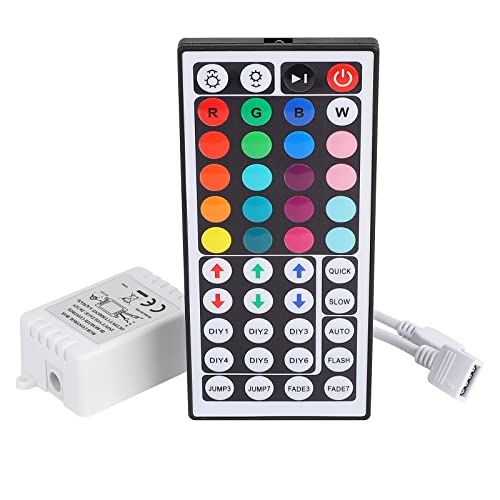
This remote controller provides 44 keys with 20 colors and 5 light patterns (Static, Flash, Strobe, Fade-change, RGB Smooth-change). It supports DC 12V strips and is designed to work with SMD RGB LED strips (4-pin). It offers on/off control and brightness adjustment. Best for general RGB strip setups requiring a broad palette and multiple effects. Caution: not compatible with RGBW strips that use 5-pin connectors or higher than 12V supply.
FUMAFI 44 Key LED Strip Remote Controller

The FUMAFI controller features 44 keys, including 20 colors and 5 patterns, with 6 DIY keys for color customization. It supports infrared control, brightness adjustment, and on/off functions. Best for users who want a straightforward remote with simple DIY color options and multiple preset patterns. Limitation: data indicates 12V operation; ensure your strip matches 4-pin configuration for reliable compatibility.
SUPERNIGHT 24 Key IR Remote Controller

This compact remote provides 16 colors and 4 light patterns, plus brightness control. It is designed for 12V DC strips, with a maximum current of 6A. Best for small installations or users who want a simple, reliable dimming experience. Caution: limited color options compared to larger remotes; may not satisfy users who require more effects or two-strip control.
GALYGG 44 Key LED Strip Controller

The GALYGG controller provides a 12V output at 5A with two ports, suitable for two strip reels. It supports IR remote control and a wide input range (100-240V) for the power adapter. Best for flexible installations where two LED reels must be synchronized. Limitation: the data emphasizes power input rather than features; verify compatibility with your specific strip type and connectors for best results.
Buying Guide
What should you consider when choosing an IR controller for LED lights?
- Voltage and current compatibility: Most RGB strips use 12V DC. Check that the controller’s output matches your strip’s requirements and total current needs when using multiple reels.
- Number of ports and reels: If you plan to run two strips simultaneously, pick a two-port model like the Ruirui or GALYGG options.
- Color and pattern options: More keys usually mean more color choices and effects. Decide if you need 16 or more colors and whether you want static, flashing, fading, or RGB-smooth modes.
- Remote range and reliability: IR remotes require a line of sight. Consider models with longer range if the controller sits behind furniture or outdoors.
- Safety and certifications: Look for CE/RoHS/FCC certifications for safer operation, especially in homes with children or pets.
- Ease of installation: Plug-and-play designs with standard 4-pin connectors simplify setup and reduce wiring errors.
How to install quickly and avoid common issues
- Match the 4-pin connectors and ensure the strip type aligns (RGB, not RGBW).
- Place the IR receiver in a clear area with a direct line of sight to the remote.
- Power the controller with a suitable 12V supply, ensuring the current rating covers all connected strips.
- Test color channels individually to confirm proper RGB output.
FAQ
- Can I use any IR remote with any LED strip?
Answer: Not all remotes are compatible with every strip. Check the connector type (4-pin) and voltage (12V) to ensure compatibility. - What if my remote loses its signal range?
Answer: Reposition the controller for line-of-sight, or consider a controller with a longer control distance or a newer IR receiver. - Are these controllers safe to touch?
Answer: Yes, most are designed for low voltage operation (12V) with low heat emission, meeting common safety standards. - Do these controllers work with two strips at once?
Answer: Some models offer dual outputs; verify the current rating and connector type before combining strips. - Can I use these with RGBW strips?
Answer: Most 4-pin controllers are designed for RGB only; RGBW strips require 5-pin connectors and a different controller. - Is certification important?
Answer: Yes, CE/RoHS/FCC certification signals safer electrical standards and regulatory compliance.