Best Lapel Mics for Podcasting and Content Creation
Answering the search for reliable lapel mics for podcasts, this guide highlights five strong options that suit different creators. Best for solo hosts, best for multi-person conversations, and best for on-the-go filming—each pick is evaluated for compatibility, portability, and audio clarity. This article helps buyers compare features and decide which mic fits their setup and workflow.
Summary table of chosen products:
| Product | Best For | Key Strength | Notes |
|---|---|---|---|
| MAYBESTA Wireless Mini Microphone (2 Pack) | Vloggers, mobile creators | Wide compatibility, easy pairing | Phone-case friendly; dual-pack |
| DJI Mic Mini | Long shoots, multi-device use | Ultra-light, long range | Excellent battery life with case |
| occiam Mini Lavalier Mic | Educators and interviewers | AI noise cancellation, 54h total life | Comprehensive features, robust kit |
| Mini Mic Pro | Creators needing plug-and-play | Out-of-box comfort, no apps | Widely compatible adapters |
| PQRQP 3 in 1 Wireless Lavalier | Livestreams and group shoots | 3 in 1 universal receiver | Supports multiple devices |
MAYBESTA Wireless Mini Microphone (2 Pack)

Best for: mobile content creators who film on smartphones, live on social platforms, or run quick podcast-style interviews while on the go. This 2-pack setup is ideal for duo hosts or spare mics for multi-guest sessions.
What to know: It’s designed for broad device compatibility, including Android, iPhone, iPad, laptops, and tablets. The receiver has an extended interface for easier use with phone cases still on, which helps when filming in tight spaces or on a desk setup. Auto-connection requires no extra apps, just the right adapter to your device.
Why selected: The dual-pack and broad compatibility make it a practical choice for beginner to intermediate podcasters who record with a mix of devices. The lack of apps and straightforward pairing minimize setup friction, helping you start recording quickly.
Caution: While convenient, the built-in system relies on compatible adapters. If your device uses an unusual port, confirm adapter availability before purchase.
DJI Mic Mini (2 TX + 1 RX + Charging Case)

Best for: creators who need reliable long-range transmission and a compact, lightweight setup for on-camera use. Suited for field recording, vlogs, and extended shoots where comfort matters.
What to know: The Mic Mini is ultralight (about 10 g per transmitter) with a claimed 400 m max transmission range and long take durations, aided by a charging case that supports up to 48 hours of operation. It emphasizes detail-rich sound and stability in outdoor environments.
Why selected: Its combination of small size, strong battery life, and robust wireless performance makes it a solid choice for longer recording sessions or multi-location podcasts where staying inconspicuous matters.
Caution: Battery life estimates depend on use conditions; real-world range can vary in crowded or wireless-dense environments.
occiam Mini Lavalier Microphone
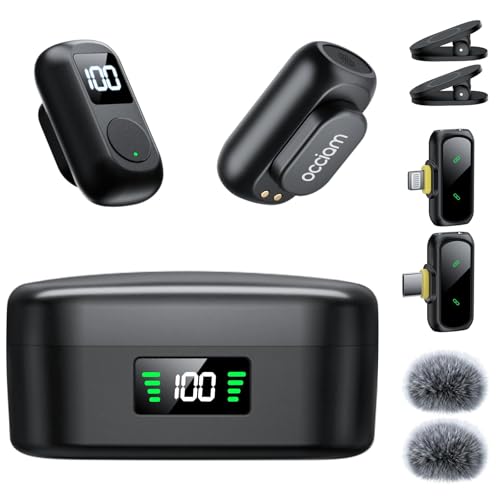
Best for: educators, vloggers, and interview-style podcasts that benefit from longer recording sessions and clear voice capture with noise control.
What to know: This mic features AI noise cancellation, a long wireless range (up to 328 ft obstacle-free), and a 54-hour total life with a charging case. An LED display helps monitor power levels, which is useful for all-day shoots.
Why selected: The kit’s comprehensive power management and noise reduction are strong for remote shoots or classroom settings where wind and ambient noise can be disruptive.
Caution: Some users may prefer simpler setups; the many features require a bit more familiarity to maximize benefits.
Mini Mic Pro (Latest Model)

Best for: creators who want a truly plug-and-play microphone that works with multiple devices without apps or Bluetooth, including iPhone, Android, tablets, and laptops.
What to know: This mic emphasizes a super easy connect, with adapters for USB-C and Lightning. It’s designed for clean voice capture in a variety of environments, including outdoor shoots, with included wind protection and foam covers to reduce wind noise.
Why selected: The lack of setup friction makes it appealing for newcomers or busy producers who need reliable, quick-on recording for friends, family, or interview scenarios.
Caution: While versatile, real-world performance depends on the adapter compatibility with your device; ensure you have the correct adapter on hand for non-standard ports.
PQRQP 3 in 1 Wireless Lavalier

Best for: livestreams, multi-person vlogs, and on-the-go reporting where a single system can serve multiple devices and scenarios.
What to know: The 3 in 1 universal receiver supports a range of devices, including iPhone models up to modern versions and many Android phones. It features active noise reduction and omni-directional pickup for comprehensive sound capture.
Why selected: Its versatility makes it a good all-around choice for producers who switch between devices or host multi-person formats without swapping gear mid-session.
Caution: The 3.5 mm output may not be compatible with all laptops without an appropriate adapter, so verify your device inputs before buying.
Buying Guide
What to consider when choosing a lapel mic for podcasting
- Device compatibility: Ensure the mic supports your primary devices (iPhone, Android, tablets, laptops, cameras). Look for USB-C, Lightning, and 3.5 mm compatibility.
- Number of mics: Solo podcasts benefit from single mics; group formats benefit from 2–4 mic kits with reliable syncing and noise reduction.
- Wireless range and battery life: Longer ranges and multi-hour battery life help with studio setups and field recording.
- Noise reduction and wind protection: For outdoor or busy environments, choose mics with AI or DSP noise reduction and protective wind screens.
- Setup complexity: If you need quick start times, prioritize plug-and-play systems with simple LEDs or indicators showing connection status.
- Carrying and portability: Compact receivers, protective cases, and clip-on mics are preferable for mobile creators.
What setup fits your podcast workflow?
- Studio-style podcast: A two-mic system with a mixer or audio interface may be best for clear, controlled sound across hosts and guests.
- On-the-go recording: Lightweight wireless mics with long battery life and durable wind shields help you capture high-quality audio outside the studio.
- Video-centric content: Choose microphones with reliable syncing, strong wind resistance, and compatibility with your camera or phone for a clean video-audio pairing.
Practical questions and answers
- Do these mics require apps? Most listed models emphasize plug-and-play operation without apps, though some may offer optional companion apps for advanced features.
- Can I use these mics with a laptop? Yes, many provide USB-C or USB-A outputs or adapters for laptops; verify port compatibility before purchase.
- Is wind protection included? Several kits include wind muffs and foam covers to reduce outdoor wind noise.
- What about multi-person recording? Some systems support up to four mics simultaneously, which is ideal for panel podcasts or interviews.
- How important is battery life? For long shoots or field recording, longer battery life reduces interruptions and recharges between takes.
- Will I need additional adapters? Depending on device ports, you may need USB-C, Lightning, or 3.5 mm adapters to connect the receiver.
FAQ
- What is a lapel microphone? A lapel mic is a small clip-on microphone designed to be worn on clothing, delivering close-range audio for clearer voice capture.
- Are wireless lavalier mics reliable for podcasts? Yes, with proper pairing and a stable receiver, they offer flexibility for hosts and guests without cables.
- Can I use these mics with social media apps? Yes, many are designed to work with smartphones for YouTube, TikTok, and livestreaming without extra software.
- Do they work in loud environments? Models with noise reduction and wind protection perform better in busy settings, but performance varies by model and environment.
- What should I buy for a two-person podcast? A two-pack wireless lavalier set or a kit that supports two mics with a reliable connection is a solid start.