Best Line Out Converter for Amp: Top Options for Aftermarket Car Audio
Answering the common buyer question: a line-out converter (LOC) enables you to add an amplifier or subwoofer to a factory or aftermarket stereo by converting speaker-level signals to RCA line-level signals. This guide highlights five reliable models suitable for different setups, from compact cars to systems demanding higher output. Best for: modifying OEM radios, upgrading subwoofers, or powering aftermarket amps without complex rewiring.
| Product | Best For |
|---|---|
| KICKER 46KISLOC2 | Best compact LOC with remote turn-on |
| Skar Audio SKAR2CH-LOC | Best for OEM and smart radios compatibility |
| Scosche LOC2SL | Best for flexible installation and bass boost |
| CT Sounds CT-LC2 | Best for bass restoration with BassLift |
| PAC SNI-35 | Best adjustable gain with transformer isolation |
KICKER 46KISLOC2 K-Series LOC with Remote

The KISLOC2 is a stereo line-out converter that uses factory speaker wires to create both RCA outputs and a 12-volt remote wire with DC offset. It accepts up to 55 watts (16 volts) input, making it suitable for many factory and aftermarket head units. Best for: installations where a compact, easy-to-wire LOC with remote turn-on is desired, especially when space is limited in the dash.
Who this is for: drivers wanting a straightforward upgrade path to an amplifier without replacing multiple harnesses. Why selected: it provides a clean signal path and a built-in remote turn-on feature for simple amp control. Caution: monitor the input wattage; exceeding 55 watts could reduce headroom or cause distortion in some systems.
Skar Audio SKAR2CH-LOC 2-Channel LOC

The SKAR2CH-LOC is a 2-channel line-out converter designed for compatibility with OEM, aftermarket, and smart radios. It accepts up to 55 watts (16 volts) and preserves a flat 20 Hz–20 kHz range across levels for consistent sound quality. Best for: users who need broad compatibility with various head units and a straightforward path to a sub or amp. Why selected: broad compatibility and flat frequency response help maintain original sound integrity. Caution: ensure your head unit supports the input stage required by the converter to avoid mismatch.
Scosche LOC2SL Line Output Converter
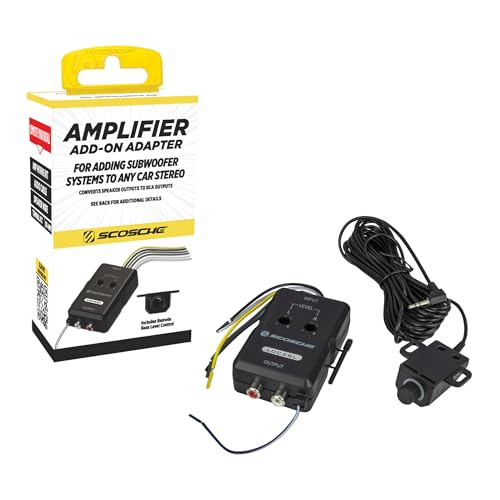
The LOC2SL offers high/low RCA conversion with flexible installation for car audio systems. It is designed to seamlessly integrate a factory stereo with an aftermarket amplifier, delivering crisp sound for subwoofers. Best for: installers who value flexible mounting options and clean signal transfer. Why selected: strong compatibility and easy wiring reduce installation complexity. Caution: ensure there is no interference from nearby electrical components in tight dash spaces.
CT Sounds CT-LC2 2-Channel LOC with BassLift

The CT-LC2 provides a 2-channel (main) output plus a low-pass bass output, coupled with BassLift technology to compensate factory bass roll-off. Best for: users upgrading a factory setup that needs stronger bass without reconfiguring the entire system. Why selected: BassLift helps recover low-end performance often lost in factory head units. Caution: while BassLift improves bass, it may require fine-tuning of the amplifier’s crossover settings to avoid muddy lows.
PAC SNI-35 Variable LOC

The SNI-35 features adjustable line-out conversion with audio transformer-based noise isolation. It is designed for factory radios and higher-volume amplifiers with RCA inputs. Best for: users who want control over output level and good isolation from noise. Why selected: adjustable gain helps tailor the signal to the amplifier, reducing potential distortion. Caution: setup may require precise gain matching to avoid clipping at high volume.
Buying Guide: Key Purchase Considerations
- Compatibility: Check whether the LOC supports your head unit type (OEM, aftermarket, or smart radio) and your amplifier’s input expectations.
- Input Power Handling: Choose a model that can handle the radio’s output wattage to avoid distortion or signal loss.
- Signal Isolation: Transformers reduce noise pickup from vehicle power lines; consider LOCs with built-in isolation if you experience interference.
- Remote Turn-On: If your amplifier should power on with the radio, ensure the LOC includes a remote turn-on output.
- Bass Handling: If boosting bass, look for BassLift or dedicated low-pass bass outputs to maintain musical balance.
- Installation Time: Some LOCs offer straightforward wiring in cramped dash spaces; others may require additional adapters or mounting brackets.
- Frequency Response: A broad, flat response (20 Hz–20 kHz) helps preserve the original music character across levels.
Frequently Asked Questions
- Do I really need a line-out converter to run an amplifier from a factory radio?
Yes, most factory radios lack RCA outputs. A LOC converts speaker-level signals to RCA line-level signals so your amplifier can drive speakers or subwoofers. - Can a LOC improve sound quality on all cars?
Results vary. A quality LOC can preserve signal integrity and reduce noise when properly matched to your system and boost needs. - What is BassLift and when should I use it?
BassLift is a technology that restores bass that factory systems may roll off. Use it when you want stronger lows without upgrading the entire radio and speakers. - Is remote turn-on necessary for amplifiers?
Not always, but it’s convenient. A remote turn-on ensures the amplifier powers on with the head unit, avoiding manual amp control. - How do I choose between a 2-channel LOC and a 4-channel LOC?
A 2-channel LOC works for one amp or sub setup, while a 4-channel LOC is suitable if you plan to drive multiple amplifiers or full-range channels. - Are there any installation drawbacks to LOCs?
Possible drawbacks include signal noise if the installation isn’t clean, or limited compatibility with some high-output head units. Always verify spec alignment with your system.