Best Liquid Flux for Electronics: Top No-Clean Options for Soldering Projects
Answering your search for reliable liquid flux for electronics, these picks cover no-clean Rosin Mildly Activated (RMA) fluxes that help remove oxides and improve solderability. Each option suits different users—from hobbyists doing PCB repair to professionals performing desoldering and rework. The top choices below are best for precise application, minimal residue, and safe storage. See the quick comparison table for a snapshot, then dive into details to find your best fit.
| Product | Key Benefit | Best For |
|---|---|---|
| BEEYUIHF Liquid Solder Flux Dropper (30 mL) | Non-corrosive, RoHS compliant, high wettability | Delicate PCB repairs and general soldering |
| QUIMTECH Liquid Solder Flux Dropper (30 mL) | Neutral pH, non-corrosive, good oxide removal | Electronics with mixed leaded/lead-free alloys |
| BEEYUIHF Liquid Flux Dropper Duo (60 mL total) | Two-pack value, same non-corrosive rosin flux | Ongoing projects or multiple boards |
| wyunway Liquid Solder Flux (30 mL) | No-clean rosin flux, electronics-grade | Pcb repair and component installation |
| TOWOT Liquid Flux (30 mL) | No-clean, lead-free, anti-corrosion | PCB repair and DIY electronics |
BEEYUIHF Liquid Solder Flux Dropper
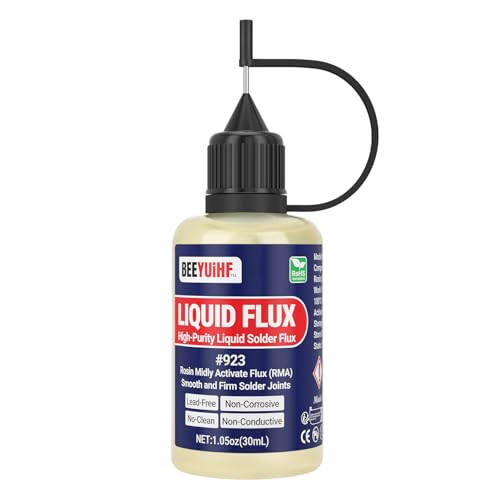
Brand: BEEYUIHF
- Non-corrosive rosin-based flux with RoHS compliance and zero chlorides.
- Safe & Reliable: Rosin Mildly Activated (RMA) flux with neutral pH; non-conductive dried residue.
- Outstanding performance for oxidized films on tin, lead, copper, silver, and nickel alloys.
Best for: Beginners and professionals seeking a dependable, non-conductive residue after soldering for general electronics repair. This option is chosen for its safety profile and strong oxide removal. Caution: Ensure adequate ventilation when applying in enclosed spaces.
QUIMTECH Liquid Solder Flux Dropper

Brand: QUIMTECH
- High-purity no-clean flux with RMA formulation; RoHS compliant and environmentally friendly.
- Effective oxide removal on tin-lead, lead-free, copper, gold, and silver alloys.
- Includes a 30 mL dropper; non-corrosive and non-conductive residue when dry.
Best for: Users who need reliable oxide removal across varied alloy types and a compact 30 mL bottle. Choose this if you work with both leaded and lead-free joints. Caution: As with all flux, avoid prolonged exposure to skin and eyes.
BEEYUIHF 60mL Liquid Flux Dropper Duo

Brand: BEEYUIHF
- Non-corrosive rosin-based flux with high purity; lead-free and RoHS compliant.
- Safe & Reliable: RMA flux with neutral pH; non-conductive dried residue provides insulation.
- Strong wettability and oxide removal for both leaded and lead-free processes; multi-bottle value.
Best for: Projects requiring more flux volume or multiple boards. Use this when you anticipate frequent soldering tasks. Caution: Store away from heat to protect bottle integrity.
wyunway Liquid Solder Flux

Brand: wyunway
- No Clean Rosin Flux designed for electronics
- Dropper bottle enables controlled, precise flux application
- Electronics-grade flux for delicate soldering and PCB repairs
Best for: Marked for precision work where controlled application reduces waste. Avoid this if you need aggressive oxide removal for heavily oxidized joints.
TOWOT Liquid Flux

Brand: TOWOT
- No-Clean RMA formula; lead-free and non-corrosive
- Neutral pH; RoHS compliant for safe electronics soldering
- Effective oxide removal on copper, silver, gold, tin-lead, and lead-free alloys
Best for: Professionals and DIYers performing PCB repair and component installation with minimal post-solder cleaning. Caution: Ensure bottle is sealed tightly to prevent drying out.
Buying Guide
What should you consider when choosing liquid flux for electronics?
- Flux type: No-clean flux leaves minimal residue that often requires no post-solder cleaning, while water-soluble flux may require cleaning after use. Most electronics work benefits from no-clean or RMA flux.
- Activation level: Rosin Mildly Activated (RMA) flux balances oxide removal with residue that insulates after drying. Consider RMA for general boards and repairs.
- Purity and safety: Look for RoHS compliance, non-corrosive formulas, neutral pH, and low hazard ingredients for safer handling.
- Packaging and quantity: Dropper bottles (30 mL or 60 mL) support controlled application. Choose quantity based on project scale and reuse needs.
- Compatibility: Ensure flux works with your solder alloy (lead-based, lead-free, or mixed) and materials (copper, tin, silver, gold, nickel).
- Residuals and insulation: Non-conductive dried rosin residues help prevent shorts; check that residues are suitable for your circuit type.
Frequently Asked Questions
- What is No-Clean flux?
No-Clean flux is a soldering flux formulated so that the residue left after soldering is non-conductive and non-corrosive, reducing or eliminating the need for cleaning.
- Is rosin-based flux safe for electronics?
Yes, rosin-based fluxes are common for electronics when designed as RMA or no-clean formulations. They are typically non-conductive when dry and provide good oxide removal.
- Can flux damage PCB traces?
Non-corrosive fluxes with neutral pH reduce risk to copper traces. Always follow proper storage and application methods to minimize contact time with sensitive areas.
- How much flux should I apply?
Apply a thin, controlled layer using a dropper or nozzle to targeted joints. Over-application can increase cleaning time or leave excess residue.
- Do I need to clean flux after soldering?
If you use no-clean or RMA flux, cleaning is often optional. Check the board’s requirements and flux instructions for best practice.
- Which flux is best for lead-free solder?
Fluxes labeled for lead-free and with strong oxide removal are ideal for lead-free solders, often with rosin-based, RMA formulations.