Best Lithium Batteries for Solar Power Storage and Home Backup
Answering the common buyer’s question: which lithium battery options deliver reliable solar storage, scalable capacity, and strong safety features for home backup? This guide highlights five top lithium battery solutions suited for solar power storage, ranging from compact 100Ah units to high-capacity 314Ah packs. It explains who each product is best for, why it’s a good match, and any potential limitations. The focus is on safety certifications, communication capabilities with solar inverters, and ease of expansion for growing solar setups. A quick summary table follows to compare key details at a glance.
| Product | Voltage | Capacity | Expansion | Best For |
|---|---|---|---|---|
| ECO-WORTHY Cubix100 48V 100Ah | 48V | 100Ah (≈5.12kWh) | Paralleling up to 32 units | Compact home backup, space-limited installs |
| ECO-WORTHY Cubix100 48V 200Ah | 48V | 200Ah (≈10.24kWh) | Paralleling up to 32 units | Residential storage with moderate expansion |
| AOUSK 48V 314Ah | 48V | 314Ah (≈16.0kWh) | Paralleling up to 15 units | Higher-capacity off-grid or whole-home backup |
| ECO-WORTHY Cubix100 48V 600Ah | 48V | 600Ah (≈30.7kWh) | Rack-muitable, multiple units | Large homes, full off-grid readiness |
| ECO-WORTHY Powermega 48V 314Ah | 48V | 314Ah (≈16.0kWh) | Paralleling up to 15 units | Advanced energy storage with active balancing |
ECO-WORTHY Cubix100 48V 100Ah LiFePO4 Battery
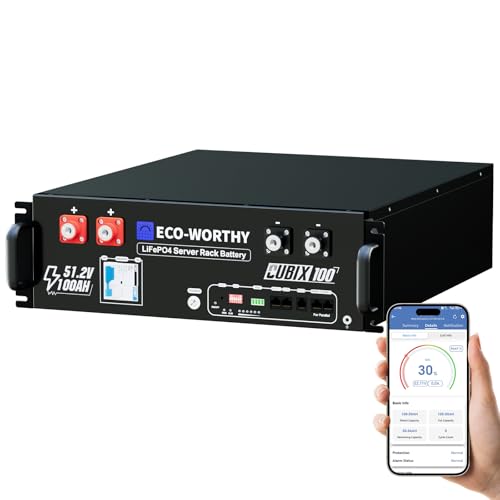
The ECO-WORTHY Cubix100 48V 100Ah battery is UL9540, UL1973, and CEC listed, with built-in Bluetooth and WiFi for remote monitoring. It uses LiFePO4 chemistry, known for thermal stability and long cycle life. Integrated CAN/RS485 interfaces support communication with compatible solar inverters for smarter system operation. Best for small to medium residential setups or as a compact backup module in a larger system. A possible limitation is the need for parallel units to scale beyond roughly 5–6 kWh, depending on your inverter compatibility.
Who it’s best for: Homeowners starting a solar storage system who want a compact, certified battery with easy app-based monitoring and expandable capacity through parallel units.
ECO-WORTHY Cubix100 48V 200Ah LiFePO4 Battery
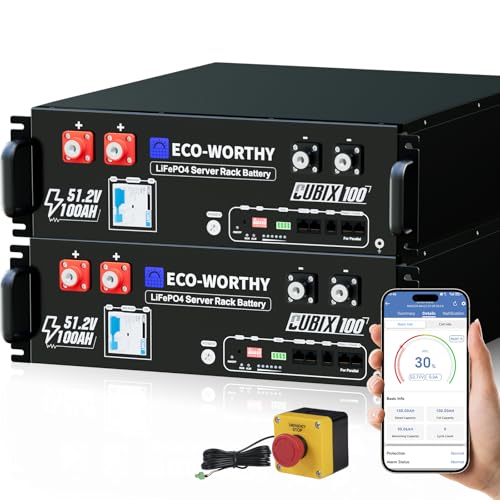
This 48V 200Ah Cubix100 package extends capacity for a more robust home storage solution. It shares the same safety certifications as the 100Ah model and supports paralleling up to 32 units for substantial expansion. Real-world appeal lies in its higher energy reserve without dramatically increasing footprint. A limitation to note is the need for a compatible inverter and communication setup to fully leverage the closed-loop CAN/RS485 interfaces.
Who it’s best for: Homeowners who want a higher energy reserve within the same compact rack footprint and plan to expand gradually via parallel units.
AOUSK 48V 314Ah LiFePO4 Battery
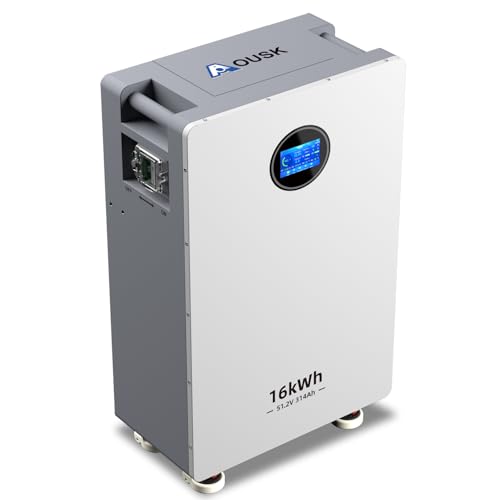
The AOUSK 48V 314Ah LiFePO4 battery provides a substantial 16.07 kWh of capacity with a robust 200A BMS and six-layer protection, including dual breakers. Real-time monitoring is available via an LCD display and a dedicated app, with RS232 for PC software. It supports parallel expansion up to 15 units, making it suitable for whole-home backup or larger off-grid configurations. A caveat is the higher initial complexity of setup due to its bigger capacity and BMS integration requirements.
Who it’s best for: Users needing higher-capacity storage with strong safety protections and remote monitoring, suitable for mid-to-large off-grid or whole-home backup projects.
ECO-WORTHY Cubix100 48V 600Ah Server Rack Battery
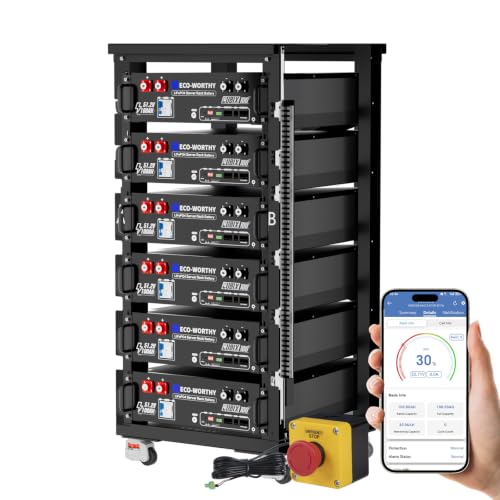
This 6-pack Cubix100 configuration delivers up to 30.72 kWh of capacity, aimed at true off-grid living or large standby needs. The rack-friendly design and space-saving alignment make it suitable for installations with server rack standards. It maintains the same safety certifications and closed-loop communication features as smaller units and can be expanded by paralleling additional packs. A potential limitation is the larger upfront footprint and the need for adequate space and cooling in rack environments.
Who it’s best for: Larger households or facilities seeking substantial, scalable solar storage with a rack-based arrangement and long-term backup reliability.
ECO-WORTHY Powermega 48V 314Ah LiFePO4 Battery

The Powermega 48V 314Ah unit features active cell balancing and a 200A BMS, along with an integrated aerosol fire protection feature for enhanced safety. It supports parallel expansion up to 15 units, delivering about 16.07 kWh per unit and enabling a total of up to 241 kWh in a multi-unit system. LCD display, Bluetooth and WiFi connectivity help supervise operations remotely. A limitation is that high-capacity configurations may require careful thermal management in enclosed spaces.
Who it’s best for: Serious off-grid enthusiasts and large backup installations that need advanced safety features, reliable expansion, and modern monitoring capabilities.
Buying Guide: Key Considerations For Solar Lithium Storage
- Safety certifications and cell chemistry: Look for UL9540/UL1973 and CEC listings. LiFePO4 chemistry offers thermal stability and long cycle life for home use.
- System compatibility: Ensure the battery communicates with your solar inverter via CAN/RS485 or RS485/RS232 and supports the data protocols your inverter requires.
- Capacity and expansion: Decide between single high-capacity packs or modular racks. Paralleling capacity directly influences how much energy you can store and how you scale over time.
- Monitoring features: In-app monitoring, LCD dashboards, and remote connectivity help you track state of charge, health, and temperature for safer operation.
- Physical footprint and cooling: Larger packs require more space and adequate ventilation. Rack-based designs benefit from structured mounting but demand clear air paths.
- Warranty and service: Consider units with long warranty periods and established service networks to minimize downtime in backup scenarios.
FAQ
- What is the advantage of LiFePO4 for solar storage? LiFePO4 offers strong thermal stability, long cycle life, and safer thermals compared with other lithium chemistries, making it suitable for home backup and continuous charging/discharging cycles.
- Can I mix different brands in one solar storage system? Mixing brands is possible if the BMS and inverter support standardized communication protocols, but it may complicate balancing and grid chemistry consistency.
- How many units can I parallel with these ECO-WORTHY batteries? Many ECO-WORTHY models support paralleling up to 15–32 units depending on the model, enabling scalable capacity for larger needs.
- What should I consider when choosing capacity? Start with your daily energy profile, reserve requirements, and future expansion plans. Higher capacity improves resilience during outages but requires more space and cooling.
- Is Bluetooth or WiFi monitoring essential? It’s beneficial for remote monitoring and quick status checks, but ensure you also have a reliable offline readout or inverter-based monitoring for critical environments.
- Are these batteries suitable for off-grid homes? Yes, several models are designed for whole-home backup and off-grid use, especially when paired with appropriate inverters and mounting racks.