Best Microphones for Teaching: Clear Classroom Sound Solutions
Choosing the right microphone can dramatically improve students’ engagement and comprehension in classrooms, lecture halls, and online teaching spaces. The following picks cover wireless lavalier mics, handheld units, headset systems, and USB options designed for reliability, ease of use, and strong sound quality. Each product is evaluated for classroom environments, including ease of setup, range, battery life, and compatibility with common devices.
The table summarizes five strong candidates for teaching scenarios, from small classrooms to larger lecture halls and hybrid setups:
| Product | Best Use | Key Strength | |
|---|---|---|---|
| Wireless Lavalier Microphone for iPhone iPad Android | Wireless Lav | Classroom and online teaching | Easy plug-and-play setup with USB-C and iOS compatibility |
| Bluetooth Microphone With Built-In Speaker (H9) | Wireless Handheld + Speaker | Large rooms, presentations, singing/lecturing | Integrated 15W speaker for amplified sound |
| MAYBESTA Wireless Mini Microphone | Wireless Lav | Mobile teaching, quick recordings | Broad device compatibility and easy connection |
| Norwii Bluetooth Voice Amplifier | Wearable/Headset | Outdoor teaching, tours, demonstrations | Lightweight with 10W power and clear projection |
| Logitech Blue Yeti USB Microphone | USB USB Mic | Online classes, podcasts, lectures | Multiple pickup patterns and broadcast-grade sound |
Below you’ll find detailed sections for five strong picks, followed by a buying guide that weighs key considerations for classroom use, device compatibility, and sound coverage.
Wireless Lavalier Microphone for Educational Use

This dual-microphone system is designed for classrooms where two speakers may present back-to-back or in tandem. Its automatic pairing reduces setup time and helps teachers move freely while delivering lectures. The omnidirectional mics pick up voices clearly, while DSP noise reduction minimizes ambient chatter, HVAC sounds, and side conversations. With USB-C and iOS connectors, this system supports iPhones, iPads, Android devices, Windows PCs, and Macs. For Android devices, enabling OTG is recommended before use.
In practice, the setup is plug-and-play: insert the receiver into the device, power on both components, and they pair automatically. The package includes two wireless microphones, enabling simultaneous use for two speakers or panel discussions. The compact design makes it suitable for desk use or podium setups, and the extended range supports larger classrooms or distance learning sessions.
Bluetooth Microphone With Built-In Speaker For Classrooms

This 2-in-1 system combines a wireless microphone with a built-in 15W speaker, delivering amplified, clear voice projection across sizable spaces. The integrated DSP and neodymium speaker deliver brighter, distortion-free audio suitable for teaching, lectures, and karaoke-style activities in a classroom or gym setting. A single, long-lasting charge supports eight or more hours of continuous use, reducing interruptions during longer classes or field trips. Note that external audio system connections are not supported in this unit.
The device is designed for immediate use with minimal setup. Teachers can activate the unit and begin speaking, with the built-in speaker handling the amplification. The system is well-suited to demonstrations, guided tours, and large group instruction where the instructor’s voice needs to reach every seat. It’s also adaptable for small events and student presentations where a compact, all-in-one solution is advantageous.
MAYBESTA Wireless Mini Microphone for Teaching

The MAYBESTA mini microphone emphasizes broad compatibility and a longer receiver interface designed to work with most smartphone cases. It supports Android and iPhone/iPad devices that use USB-C adapters, making it a practical choice for classrooms with mixed device ecosystems. The setup is simple: ensure Bluetooth is off, power on both the receiver and transmitter, and verify green indicators signal successful pairing. It is well-suited for on-the-go teaching, quick video captures, and remote or hybrid instruction where portability matters.
The kit enables content creators and teachers to record lectures, interviews, or demonstrations on social platforms like YouTube or TikTok. Its emphasis on a stable connection and straightforward operation helps minimize technical disruptions, allowing instructors to focus on pedagogy rather than configuration. The longer receiver helps accommodate various phone models and cases, reducing the need to remove protective covers during filming.
Norwii Bluetooth Voice Amplifier For Teaching
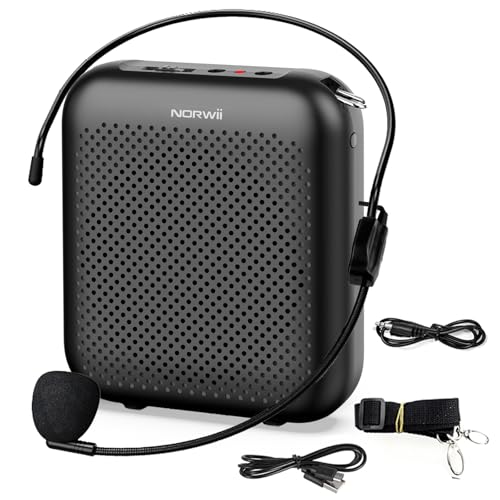
The Norwii voice amplifier is tailored for educators who need to address larger groups or outdoor audiences. With a 10-watt output and a lightweight headset microphone, it projects voice clearly over longer distances, improving audience comprehension. The design prioritizes portability for field trips, gym classes, and outdoor demonstrations. Its built-in circuit reduces feedback and keeps the audio from becoming piercing, helping protect teachers’ vocal health during long sessions. The device runs on USB-C rechargeable power, ensuring quick replenishment between classes.
This system supports a broad range of teaching activities, from classroom lectures to guided tours. The headset integration aids mobility, allowing instructors to move around without tethering to a desktop. While it is designed to be simple to operate, teachers should verify that the headset mic is properly positioned to maintain consistent sound quality and to avoid feedback in louder environments.
Logitech Creators Blue Yeti USB Microphone

This USB microphone is a staple for online teaching and recorded lectures. Its multi-pattern design lets instructors switch among cardioid, omni, bidirectional, and stereo pickup patterns to tailor sound capture to different activities, such as single-person lectures, panel discussions, or ensemble performances. The onboard controls give quick access to headphone volume, mic gain, mute, and pattern selection, enabling rapid adjustments during live classes. The Blue Yeti yields broadcast-quality sound ideal for Zoom, YouTube recordings, podcasts, and other virtual learning formats.
For classrooms that blend in-person and remote learners, the Blue Yeti provides reliable, plug-and-play performance with minimal setup. Its versatility supports a range of teaching tasks—from podcast-style lectures to interview-based assessments—and its robust build quality helps withstand daily classroom use. While more expensive than entry-level units, its flexibility and sound quality can justify the investment for schools emphasizing digital content creation and high-quality audio for students.
Buying Guide: How To Choose The Right Teaching Microphone
- Coverage Area: For small classrooms, lavalier mics or compact handheld units often suffice. In larger rooms, consider a headset or a system with a higher output power and a capable receiver.
- Device Compatibility: Identify whether you primarily teach in person, online, or in a hybrid setting. USB-C, USB-A, iOS, and Android compatibility determine how easily the mic integrates with your devices.
- Ease Of Use: Look for plug-and-play setups, auto-pairing features, and clear LED indicators to minimize downtime between classes.
- Battery Life: For daily classes, choose devices with long battery life or easily rechargeable power sources to prevent mid-lesson interruptions.
- Audio Quality And Noise Suppression: DSP noise reduction and wind screens help maintain clear voice capture in classrooms with HVAC systems or outdoor environments.
- Mobility And Comfort: For teachers who move around, wireless lavaliers or headset mics offer hands-free operation without sacrificing sound quality.
- Price And Durability: Consider total cost of ownership, including spare parts, charging cables, and replacement mics, along with the device’s build quality for daily use.
In summary, the best option depends on room size, teaching style, and the classroom’s technical ecosystem. For hybrid courses and frequent recording, USB microphones with flexible pickup patterns provide versatility. For instructors who move through the room, wireless lavaliers and headset systems offer comfort and reliability. When addressing large outdoor spaces or gym settings, a powerful voice amplifier can ensure messages reach every listener. The five picks above present a spectrum of capabilities suitable for diverse teaching environments.