Best Mixer for Live Performance: Top 5 Live-Ready Audio Mixers for Stage and Studio
Yes, a dedicated live performance mixer can dramatically improve vocal clarity, instrument balance, and overall audience impact. This guide highlights five capable options suited to different performers, from DJs and podcasters to small bands and solo artists. Each pick prioritizes easy setup, durable build, and flexible connectivity for live venues, rehearsals, or streaming. Below, find concise buyer notes, ideal use cases, and practical limits to help you choose the right mixer for your show.
| Product | Best For | Key Benefit |
|---|---|---|
| K-mxerpro 8 Channel Professional Audio Mixer | Small bands, live streaming | USB audio interface, 8 mic inputs, Bluetooth |
| W IN-MIX DX12 12-Channel Mixer | DJ setups, studio-to-stage | 99 DSP effects, independent 48V power per channel |
| FULODE 16-Channel Audio Mixer | Karaoke nights, mid-size venues | 99 DSP effects, Bluetooth and USB playback |
| FULODE 12 Channel Audio Mixer | Studio recording, live performances | Multi-input versatility, Bluetooth streaming |
| Yamaha MG20 20-Input Mixer | Professionally polished live sounds | Studio-grade preamps, clean sonic character |
K-mxerpro 8 Channel Professional Audio Mixer

The K-mxerpro 8-channel mixer is designed for flexible live setups. It offers 8 mic inputs with XLR and 1/4″ connections, plus REC and TAPE I/O for easy routing during performances. A 6.5mm headphone jack supports private monitoring so performers can hear themselves clearly on stage. Best for small bands, podcasters on the move, or streaming presenters who need compact, capable control without sacrificing input variety.
Best for: small bands, live streamers, or event hosts who require multiple mic channels and straightforward monitoring. Why chosen: its combination of mic inputs, USB audio interface, and Bluetooth streaming provides a complete, all-in-one solution for live shows and online broadcasts. Limitation: may lack the scale and advanced routing of larger 12- or 16-channel consoles for bigger venues.
W IN-MIX DX12 Professional DJ Audio Mixer

The W IN-MIX DX12 is built for stage and studio use with 12 independent channels, each featuring 3-band EQ and gain control. It adds 99 DSP effects, a 7-band master EQ, and dedicated mute buttons, plus Bluetooth streaming and USB recording. This makes it ideal for DJs, podcasters, and live performers who want creative sound shaping on the fly. Best for: performers needing abundant effects and precise channel control. Caution: with more features comes a steeper learning curve for beginners, but the layout supports quick access once familiar.
FULODE 16-Channel Audio Mixer

The FULODE 16-Channel mixer provides robust multi-channel capability, Bluetooth input, USB playback, and a 7-band graphic master EQ. It includes 99 DSP effects for versatile live performance and studio work, enabling dramatic sound design for venues of varying sizes. Best for: mid-size venues, bands, or karaoke setups that require flexible effects and easy USB/Bluetooth connectivity. Caution: the dense feature set may be more than needed for solo artists with simple needs.
FULODE 12 Channel Audio Mixer
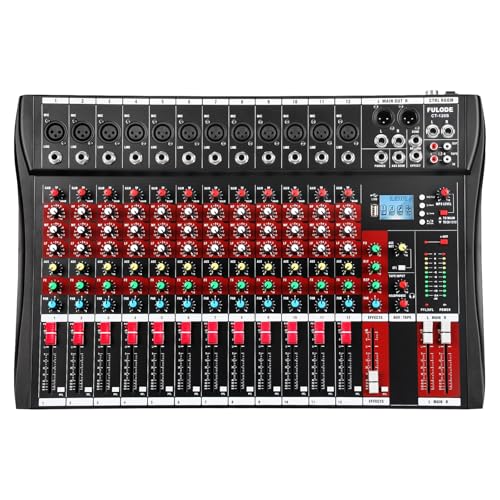
This 12-channel model emphasizes flexible input options, +48V phantom power on select channels, and USB/MP3 playback along with Bluetooth streaming. It features a 3-band EQ per channel, LED indicators, and a large display for quick level checks. Best for: studio-to-stage transitions, small bands, and performers who value Bluetooth playback and USB recording. Limitation: some users may prefer deeper channel routing or effects not included on the basic model.
Yamaha MG20 20-Input Mixer

The Yamaha MG20 is a larger 20-input mixer without built-in USB or effects, but it uses studio-grade discrete preamps and a robust 3-band EQ with high-pass filters to deliver clean, punchy mixes. It’s best for performers who want high-quality analog sound shaping and a reliable path for larger live setups where digital routing isn’t required. Best for: venues with ample inputs needing a clean, natural mix. Caution: lacks built-in effects and USB recording, which may require additional gear for modern streaming setups.
Buying Guide: How To Choose The Right Live-Performance Mixer
- Channel count and input types: For solo acts or small groups, 8–12 channels may suffice. Bands or multi-instrument acts benefit from 16–20 channels. Look for XLR and 1/4″ inputs, plus any mic preamps and phantom power if you plan to use condenser mics.
- Built-in effects vs. external gear: If you value on-board reverb, delay, and compression, prioritize models with DSP effects. If you already own external processors or prefer simpler sound, a clean mixer with routing flexibility may be better.
- Connectivity for playback: Bluetooth and USB playback/recording simplify rehearsal and live show workflows. USB recording lets you capture performances directly to a computer or drive.
- Monitoring and feedback control: Look for dedicated headphone outputs, direct monitoring options, and mute/solo controls to manage stage sound and on-air feedback.
- Portability and build quality: For touring or mobile gigs, weigh weight, ruggedness, and chassis design. A compact, sturdy mixer reduces setup time and transport stress.
- Future-proofing: Consider whether your needs might expand to USB-C, higher sample rates, or additional outs for external processors and monitors in the coming years.
Frequently Asked Questions
- What’s the most important feature in a live-performance mixer? A reliable mic preamp quality, adequate channel count, and clear routing options are foundational for clean sound on stage.
- Do I need built-in effects for live use? Effects can simplify sound shaping on stage, but they are not essential if you prefer external processors or a straightforward mix.
- Is USB recording necessary for live shows? USB recording is convenient for archiving performances and post-show editing, but not mandatory for all gigs.
- Should I choose a larger mixer for future expansion? If you anticipate adding more mics, instruments, or streaming setups, a 12–20 channel mixer provides room to grow without buying again soon.
- What about Bluetooth in a live mixer? Bluetooth enables quick playback from mobile devices or tablets, but it can introduce latency if not managed carefully. Use wired sources for critical monitoring when possible.
- Are analog mixers better than digital for live sound? Analog mixers offer straightforward control and a traditional feel. Digital mixers provide extensive routing, memory presets, and effects, but may require more learning.