Best Multimeters for Electronics Repair: Top 5 Tools for DIY and Professionals
Choosing the right multimeter is essential for reliable electronics repair. This guide highlights five highly capable tools that blend measurement accuracy with practical features for soldering, debugging, and troubleshooting. Each product entry includes a quick snapshot, a linked purchase option, and key capabilities to help you compare at a glance. Whether you’re assembling hobby projects or maintaining complex circuits, the right multimeter can streamline diagnostics and improve repair outcomes.
| Product | Brand | Key Benefit | Link |
|---|---|---|---|
| Soldering Iron Kit, 60W with Multimeter | Plusivo | All-in-one soldering kit with safety features | View |
| 2-in-1 Oscilloscope Multimeter | IMARS | Integrated oscilloscope and multimeter for debugging | View |
| 3-in-1 Oscilloscope Multimeter | IMARS | True RMS multimeter with signal generation | View |
| AstroAI Digital Multimeter | AstroAI | Wide feature set with auto-ranging and True RMS | View |
| FS899L USB Rechargeable Multimeter | CBGYYWF | USB rechargeable with CAT safety ratings | View |
Plusivo Soldering Iron Kit With Multimeter
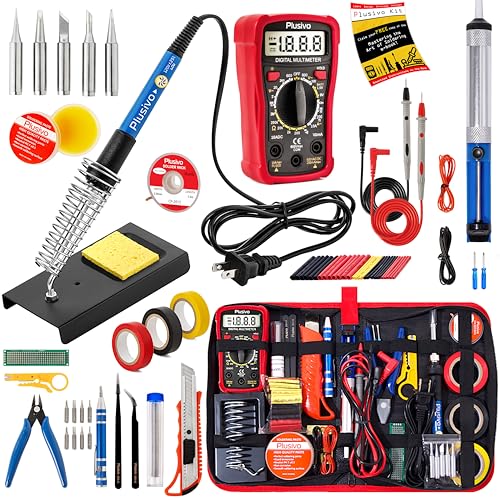
The Plusivo kit combines a complete 60W soldering iron setup with a digital multimeter and over 20 bonus items. It features a heat-resistant cap and grip for safe handling, a stand, and a comprehensive accessory set designed for electronics hobbyists and repair work. The included multimeter provides essential protection while testing circuits, aiding quick troubleshooting and circuit board welding tasks. This all-in-one approach is ideal for beginners seeking an integrated toolbox for home projects, small repairs, and learning soldering techniques.
IMARS 2-in-1 Oscilloscope Multimeter
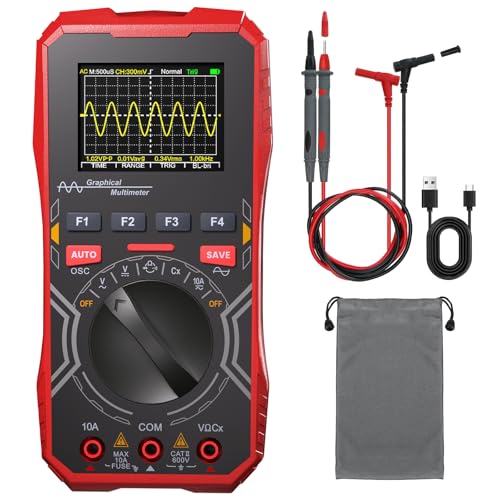
This model blends an oscilloscope and auto-ranging multimeter in one compact device. It features a 1MHz bandwidth, 2.5MSa/s sampling rate, and a 2.4″ backlit display, enabling waveform visualization and electrical parameter measurements. It is well-suited for electronics beginners, students, and DIY enthusiasts who need to visualize signals while testing voltage, current, resistance, and continuity. The combined tool reduces clutter and simplifies diagnosing issues in power supplies, microcontroller projects, and basic circuits, making it a versatile option for learning and repairs.
IMARS 3-in-1 Oscilloscope Multimeter With Signal Generator

This 3-in-1 device combines an oscilloscope, true RMS multimeter, and a signal generator. With a 12MHz bandwidth and 50MS/s sampling rate, it captures mid-to-low frequency signals accurately. It supports AC/DC voltage up to 1000V, current up to 10A, and comprehensive resistance, capacitance, and frequency testing. The integrated signal generator enables creating test waveforms, simplifying debugging and validating circuitry for educational labs, hobby projects, and repair scenarios without juggling multiple instruments.
AstroAI Digital Multimeter

The AstroAI multimeter offers a broad test suite including AC/DC voltage, current, resistance, continuity, capacitance, frequency, and diode testing with a large backlit LCD, data hold, and a kickstand for hands-free measurements. Auto-ranging and True RMS features enhance accuracy for both residential and professional applications. The device is designed for straightforward operation, making it suitable for quick diagnostics on power supplies, electronic circuits, and automotive testing in a laboratory or workshop setting.
FS899L USB Rechargeable Multimeter

This USB-rechargeable multimeter emphasizes safety with IEC CAT III 1000V and CAT IV 600V ratings, double fuse protection, and a robust housing with drop resistance. It provides true RMS measurements, a 6000-count display, and a broad measurement range for voltage, current, resistance, capacitance, frequency, and temperature. It also includes non-contact voltage detection and a compact form factor suitable for fieldwork or shop use where portability and safety are priorities.
Buying Guide: Key Considerations For Selecting A Multimeter
- Voltage and current ranges: Ensure the device covers the voltages and currents typical in your projects, including high-voltage and high-current applications if needed.
- RMS vs. average-responding: True RMS meters yield more accurate readings for non-sinusoidal signals, important in modern switching circuits and audio electronics.
- Auto-ranging vs. manual: Auto-ranging simplifies use, but some professionals prefer manual range control for faster measurements in known ranges.
- Additional functions: Oscilloscope integration, capacitance, temperature, frequency, diode tests, and continuity help diagnose diverse problems without extra tools.
- Safety ratings: Look for CAT III/IV ratings when working with mains or automotive electronics to reduce risk during measurement.
- Display and usability: A clear, backlit display, data hold, and easy navigation speed up work in dim environments or crowded test benches.
- Portability and durability: For field repairs, consider USB-rechargeable options or rugged housings with protective features.
- Accessories: Probes, clips, and lead kits influence measurement convenience and safety—select compatible, insulated probes for your meter.
- Learning needs: For beginners, kits with guided manuals or starter projects can accelerate competency and reduce errors.
- Upgrade path: If you anticipate expanding to more complex diagnostics, choose a model with scalable features or future-proof capabilities.