Best Optical Bluetooth Transmitters for TV: Clear, Private Sound for Any Setup
Answering the common search intent for an optical Bluetooth transmitter for TV, this guide reviews five top options that fit different living rooms and needs. Each product section explains who it’s best for, why it’s recommended, and any notable limitations. Ideal buyers include: night owls wanting dual listening, seniors needing simple pairing, and households seeking reliable long-range performance.
Summary table of chosen products:
| Product | Best For | Key Advantage | Limitations |
|---|---|---|---|
| SOOMFON 3-in-1 Bluetooth Transmitter | Dual listeners, multi-room use | LCD display, volume control, Dual Connection | Transmitter/receiver versatility may be more than needed for simple use |
| 1Mii B06TX | Budget upgrade for non-Bluetooth TVs | Low-latency options, easy plug-and-play | Not a receiver; only TX |
| Avantree Audikast 3 | Optical-only TVs with easy setup | Simple setup, PCM requirement, dual headphones | Not compatible with HDMI/eARC/TVs without optical |
| SOOMFON Dual Antenna Transmitter | Stable long-range performance | Dual antennas, strong range, 3-in-1 | Interface may be busier than basic adapters |
| 1Mii B06TX+ | Two-user shared watching with clarity | Screen display for pairing, aptX options | Some codecs downgrade with dual connections |
SOOMFON 3-in-1 Bluetooth Transmitter for TV

The SOOMFON 3-in-1 Bluetooth transmitter is designed to serve multiple listening scenarios. It functions as a transmitter, receiver, and bypass adapter, making it a flexible choice for TVs, home stereos, and Bluetooth headphones. It supports dual connections, letting two headphones or speakers pair simultaneously, which is ideal for couples or roommates who want private listening without disturbing others.
Best for: households needing dual listening with a compact, all-in-one device. The built-in LCD display helps users monitor status, and volume control is available for devices lacking their own controls, such as AirPods. A practical limitation is that the 3-in-1 design can be more feature-dense than needed for single-user setups, potentially adding a few extra steps in simple use cases.
1Mii B06TX Bluetooth 5.3 Transmitter for TV

This model is positioned as a budget-friendly upgrade for non-Bluetooth TVs. It supports multiple inputs (AUX, RCA, Optical, Coaxial) and emphasizes ease of use: plug in, power up, and the device will automatically connect. It supports dual-link for two headphones or speakers, good for sharing without extra hardware. The main caveat is that it is a transmitter-only device, not a receiver, so it cannot accept audio from Bluetooth devices back to the TV or speakers.
1Mii B06TX+ Long Range Bluetooth 5.3 Transmitter

The B06TX+ emphasizes long-range performance and a clear screen display for pairing status. It supports dual-link functionality and aptX Low Latency/Adaptive/HD, aiming to deliver synchronized audio with compatible headphones or speakers. It’s a good pick when a simple, reliable private listening setup is needed for larger rooms. Note that when two aptX LL/HD devices connect, codec downgrades may occur, potentially affecting audio fidelity for some combinations.
SOOMFON Dual Antenna Bluetooth Transmitter

This SOOMFON model uses a dual-antenna design and Bluetooth 5.3 for stronger signal and stability. It’s a robust option for TV-to-headphones or speakers, offering TX, RX, and bypass modes. With a practical range of up to 15 meters in TX mode and 20-30 meters in RX mode, it supports flexible layouts across rooms. Best for: users who value reliable performance and want a single device that handles multiple modes. Limitation: a busier interface and more setup decisions may be needed for beginners.
1Mii B06TX+ Long Range Bluetooth 5.3 Transmitter
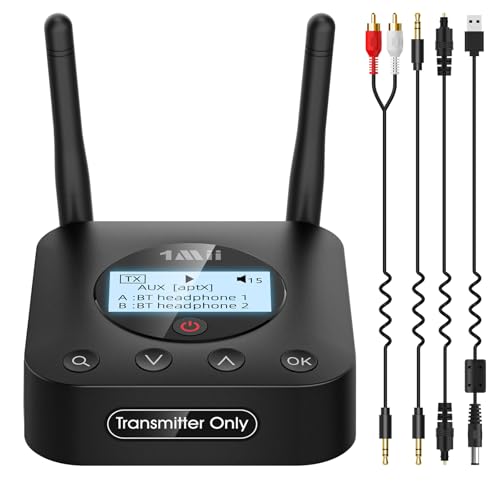
Note: The B06TX+ model is designed for long-range performance and dual connectivity. It supports aptX Adaptive and aptX HD for higher fidelity when paired with compatible devices. A consideration is that if two aptX LL/HD devices are connected simultaneously, audio codecs may downgrade, so match devices accordingly. It’s well-suited for viewers who want high-quality sound across larger living spaces and multiple listeners.
Buying Guide
- Connection options and compatibility: Look for Optical, AUX, RCA, and USB inputs to match your TV and speakers. Some models also offer coaxial inputs or bypass modes for non-Bluetooth gear.
- Number of simultaneous connections: If you frequently watch with others, prioritize Dual Link or Dual Connection features to connect two headphones or speakers at once.
- Latency and codecs: For lip-sync accuracy, seek models supporting aptX Low Latency or aptX Adaptive. Ensure your headphones or speakers support the same codec for best results.
- Ease of use: LCD displays, visible status indicators, and simple pairing processes help users who want quick setup without tech‑savviness.
- Range and environment: Real-world ranges vary with walls and obstacles. If your TV room has multiple walls, choose devices marketed with longer TX/RX ranges or dual-antenna designs.
- Power and form factor: Check how the device is powered (USB vs. wall adapter) and its size, especially if your setup has limited space behind the TV or console.
- Bypass mode utility: Bypass can be useful for upgrading existing wired stereo systems without streaming through Bluetooth, giving flexibility across equipment.
Frequently Asked Questions
- What is the difference between a Bluetooth transmitter and a Bluetooth receiver for TV?
Answer: A transmitter sends audio from the TV to Bluetooth headphones or speakers. A receiver accepts Bluetooth input and outputs it to a wired speaker. Some devices combine both functions (3-in-1). - Do all TVs require a specific port to work with these devices?
Answer: Most work via Optical (TOSLINK), AUX, or RCA. Not all TVs offer Optical output or support external adapters, so verify ports before purchase. - Is dual-link always beneficial?
Answer: Dual-link is beneficial when two listeners want private audio. However, some codecs may downgrade when two devices connect, so test compatibility with your headphones. - Will these devices work with gaming consoles or PCs?
Answer: Yes, many support Optical/AUX input from TVs or PCs. Verify that the selected model supports the desired source device and latency requirements. - What should I check before buying to avoid audio lag?
Answer: Look for Low Latency or Adaptive codecs and verify your headphones or speakers also support them. Ensure your TV is set to compatible audio formats (PCM) if needed. - Can I use these devices with non-Bluetooth stereos?
Answer: Yes, many include bypass or RX modes to connect wired stereo systems to Bluetooth devices for wireless playback.