Best Range Wifi Router for Modern Homes: Fast, Reliable Wi‑Fi Across Every Room
Finding a router that delivers solid coverage, strong speeds, and advanced features can dramatically improve home networking. This guide highlights five standout TP-Link models that emphasize range, stability, and future-ready technology. Each product is evaluated for coverage area, multi-device performance, and security features to help you choose the best range-focused router for streaming, gaming, and smart-home ecosystems.
Product Snapshot
| Product | Brand | Core Strength | Notable Tech |
|---|---|---|---|
| Archer AX21 (AX1800) | TP-Link | Wi‑Fi 6 dual‑band | Open VPN/PPTP, Alexa compatibility |
| Archer BE6500 (BE400) | TP-Link | Wi‑Fi 7 dual‑band | 2.5G ports, MLO, HomeShield |
| AXE75 (Wi‑Fi 6E Tri‑Band) | TP-Link | Wi‑Fi 6E with 6 GHz band | 6 GHz ultra‑wide bandwidth, OFDMA |
| Archer BE230 (BE3600) | TP-Link | Wi‑Fi 7 dual‑band | Multi‑Link, 2.5G WAN/LAN |
| Archer BE260 (BE5000) | TP-Link | Wi‑Fi 7 tri‑band | MLO, 5‑stream, VPN/Private IoT |
Below you’ll find concise, objective overviews of five TP-Link routers designed to maximize range and performance, followed by a practical buying guide with key considerations for choosing the right model for your home.
TP-Link Archer AX21 — AX1800 WiFi 6 Router
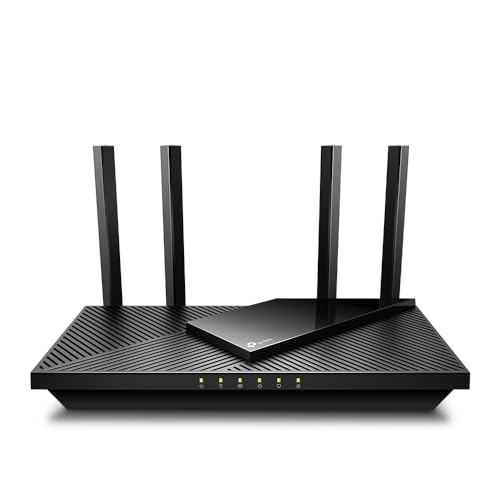
The AX21 is a compact, dual‑band Wi‑Fi 6 router designed to deliver reliable coverage for typical multi‑device households. Its AX1800 total bandwidth supports up to 1200 Mbps on the 5 GHz band and up to 574 Mbps on the 2.4 GHz band, which helps smooth streaming and gaming across several rooms. Security features include VPN server options (Open VPN Server and PPTP VPN Server), and the device integrates with Alexa for voice control. While it emphasizes speed and basic smart-home compatibility, its strength lies in easy setup and solid steady performance for mid‑sized spaces.
TP-Link Archer BE6500 Dual‑Band Wi‑Fi 7 Router

Be6500 marks a leap into Wi‑Fi 7 technology with dual‑band performance and multi‑gigabit capabilities. It features 6.5 Gbps total bandwidth and a robust 2.4 GHz/5 GHz distribution to support many devices simultaneously. The router emphasizes extensive coverage with multiple antennas and Beamforming, which helps maintain strong signals across larger homes. USB 3.0 adds local storage or printer sharing, while HomeShield and Private IoT features bolster network security for connected devices.
TP-Link AXE5400 Tri‑Band WiFi 6E Router Archer AXE75

The AXE75 delivers a true Wi‑Fi 6E experience with a dedicated 6 GHz band and tri‑band operation. Its 5400 Mbps peak rate supports demanding gaming, 4K/8K streaming, and heavy downloads across multiple devices. The inclusion of 6 GHz bandwidth reduces interference and latency for compatible devices, while OFDMA and MU‑MIMO help when many gadgets are connected. This model is best for households with numerous smart devices and a desire for near‑zero latency in gaming or video calls.
TP-Link Dual‑Band BE3600 Wi‑Fi 7 Router Archer BE230

The BE230 Becomes a versatile up‑level dual‑band Wi‑Fi 7 router, featuring Dual‑Band Wi‑Fi 7 speed with 3.6 Gbps total bandwidth and a strong emphasis on reliable multi‑device performance. It brings Multi‑Link Operation (MLO) and 2.5 Gbps WAN/LAN options for fast backbone connections. The design supports easyMesh and Private IoT, enabling scalable network expansion and tighter protection for connected devices, making it a suitable choice for growing homes with many networked devices.
TP-Link Archer BE260 BE5000 — Wi‑Fi 7 Tri‑Band

The BE260, part of TP‑Link’s Wi‑Fi 7 lineup, is a tri‑band powerhouse designed for high‑density homes. It includes up to 5 Gbps class performance, 2.5G ports, and a broad antenna array to maximize range and signal quality. With MLO and Private IoT, it’s oriented toward both performance and secure, scalable home networks. The BE260 is well suited for households with multiple streaming devices, online gaming, and smart home hubs that require steady, wide coverage.
Buying Guide: Key Considerations For Choosing A Range‑Focused Router
- Coverage area and home layout: Look for models offering strong beamforming and multiple antennas to extend range to distant rooms, basements, or garages. Wi‑Fi 6/6E and Wi‑Fi 7 generally provide better coverage for larger homes.
- Device density and simultaneous use: If many devices (phones, laptops, TVs, IoT devices) connect at once, prioritize OFDMA, MU‑MIMO, and Multi‑Link Operation (MLO) features to minimize congestion and latency.
- Band choice and future‑proofing: Wi‑Fi 6E and Wi‑Fi 7 routers add 6 GHz or advanced 2.4/5 GHz channels for higher throughput and lower interference, especially in dense wireless environments.
- Wired backhaul and ports: Check for multiple 2.5G ports and robust WAN/LAN options to support fast internet plans and future upgrades with compatible modems or switch gear.
- Security and smart home integration: Features like HomeShield, VPN servers, Private IoT, and easyMesh help manage devices securely and scale your network as you add smart devices or mesh extenders.
- Setup and management: Simpler routers reduce setup friction, while advanced interfaces provide granular controls for seasoned users. Consider routers that support mesh extensions if you plan to expand coverage later.
- Voice assistants and ecosystem: If you use voice control or smart speakers, consider models with compatible integrations and straightforward app experiences for quick management.
- Reliability vs. peak speeds: A higher theoretical speed is impressive, but real‑world performance depends on interference, walls, and device distance. Prioritize stability and consistent range for daily use.
In sum, the listed TP-Link routers represent a spectrum of range‑centric options—from solid Wi‑Fi 6 offerings to next‑gen Wi‑Fi 7 devices with multi‑gig ports and HomeShield security. Your ideal choice depends on home size, device count, and whether you want future‑ready features such as 6 GHz support or easy expandability via mesh.