Best Rear View Camera Systems for Motorhomes and RVs
Answering the question, these rear view camera systems are designed to help RV and motorhome drivers back up, park, and drive with greater awareness. They suit different buyers: solo RV travelers seeking plug‑and‑play installs, trailers and fifth wheels needing stable wireless signals, and large motorhomes requiring wide viewing angles and night vision. Below are five carefully chosen options with clear strengths for various setups.
| Product | Best For | Key Benefit |
|---|---|---|
| Yakry Y27-N | Rigs with Furrion pre-wiring | Dual antennas and long-range signal |
| Yakry Y14 | Two-camera installs | Plug‑and‑play wired kit |
| Wkzay Plug-Play RV Camera System | Pre-wired RVs | 8″ HD display, easy 20‑minute setup |
| AUTO-VOX Wireless RV Backup Camera System | Flexible, easy setup | 7.2″ DVR monitor with wide view |
| VTimes Wireless Backup Camera | Long-range wireless for large rigs | 984 ft signal, BSD alert option |
Yakry Y27-N RV Backup Camera Wireless

Best for: RVs and motorhomes that are pre-wired for a Furrion system or require a robust wireless option with a wide coverage. The Y27-N uses a dual-antenna design to deliver a more stable signal and a higher refresh rate, with a claimed range up to 825 feet in open areas and up to 320 feet on the vehicle. It supports expansion to up to four cameras and includes a prewired Furrion bracket for easier installation. This makes it well-suited for larger rigs where a single camera often isn’t enough. A potential limitation is reliance on the compatibility with Furrion‑prewired ports for the best experience.
Why choose this: The dual antennas and prominent 1080P display deliver clear night vision and a wide field of view, which helps when backing into crowded campsites or navigating tight spaces. The 30-minute DIY installation claim supports quick upgrades for DIY enthusiasts. If you’re planning to add more than one camera, Y27‑N’s expandable design is a major advantage.
Potential caveat: Ensure your RV is compatible with the Furrion pre-wired setup to avoid extra adapters or wiring steps.
Yakry Y14 Plug and Play — No Delays 2 Channels

Best for: RVs and trailers that prefer a wired, plug‑and‑play solution with reliable signal transmission. The Y14 emphasizes a simple 8‑minute installation and a direct connection from camera to monitor via a 66-foot cable. It’s ideal for drivers who want minimal setup fuss and a stable image without the risk of wireless interference. A limitation to note is that wired systems require routing cables along the vehicle, which may be more work on some rigs.
Why choose this: The inclusion of an IR night vision feature and a 150° viewing angle enhances safety in low light and helps with lane changes. The 2‑channel design allows a second camera later if you want more coverage, making it a practical upgrade for those starting with a single‑camera setup.
Caution: Ensure you have a clear route to run the cable from camera to monitor without compromising vehicle wiring or aesthetics.
Wkzay Plug-Play RV Camera System

Best for: Solo RV travelers and campers who want a Furrion-ready, plug‑and‑play system with a large 8″ monitor. The package emphasizes no drill installation, a quick start, and a wide display to spot obstacles at a glance. It’s especially suitable for pre-wired RVs or trailers where a camera cable simply plugs into a Furrion port. A potential limitation is compatibility with non‑Furrion pre-wired systems, which may require adapters.
Why choose this: The 8″ HD monitor provides a clearer view of the rear area, which helps during campsite parking and hitching. Night vision and automatic IR support improve usability in low-light camping areas. If you want a straightforward upgrade that minimizes install time, this is a solid pick.
Caution: Verify that your vehicle uses a compatible Furrion pre-wired configuration to ensure seamless operation.
AUTO-VOX Wireless RV Backup Camera System (7.2″ Monitor)

Best for: RVs and travel trailers that benefit from a comprehensive wireless system with a single, larger display. The 7.2″ monitor provides a broad, clear field of view, with split-view options for rear and side coverage. It supports pre-wired RVs and non pre-wired rigs with adapters, offering flexible installation. A caution is that wireless performance can vary by terrain and interference; line-of-sight range may be affected by buildings or trees.
Why choose this: The system emphasizes smooth wireless performance up to 60 feet or more, with a wide 1080P image ideal for spotting license plates and distant obstacles. The ability to switch between full screen and split view improves maneuvering in tight campsites or when backing into a site that requires precise alignment.
Limitation: Wireless range can be affected by environmental factors; consider a wired backup option for very long trailers or high‑demand settings.
VTimes Wireless Backup Camera System
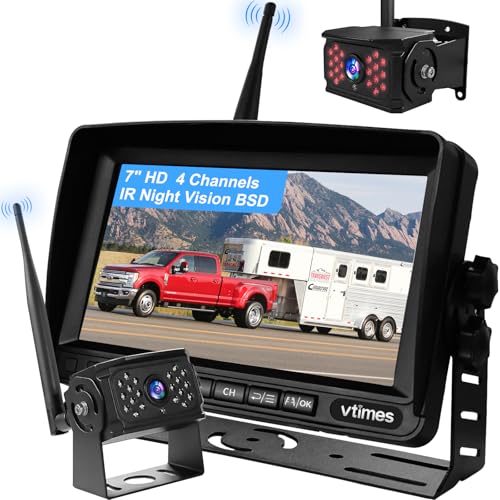
Best for: Drivers needing long-range wireless performance and BSD (blind-spot detection) alerts. The kit offers a strong signal up to 984 feet in open areas and a 120° viewing angle with 152° camera coverage. It’s suitable for larger RVs, fifth wheels, and trucks where signal stability and wide coverage are critical. A potential limitation is the availability of BSD alerts as a configurable feature, which may vary by unit.
Why choose this: The long signal range helps maintain a stable feed on extended rigs, while the BSD alert adds a proactive safety layer for lane changes and rear traffic monitoring. If you regularly travel on longer routes with multiple vehicles in convoy, this system can provide more consistent visibility than shorter-range options.
Limitation: Some users may prefer a wired option for guaranteed signal stability in remote sites or dense forests where wireless signals can fluctuate.
Buying Guide
What to consider when shopping for a motorhome rear view camera system:
- Installation style: Wired vs. wireless. Wired setups offer stable video with less potential interference, while wireless systems provide easier mounting and fewer cables, especially on pre-wired RVs.
- Display size and resolution: Larger displays like 7–8 inches with 1080P give clearer details at a driver’s seat distance. Consider if you need split-view or single-view modes.
- Camera angle and night vision: Look for wide viewing angles (120–152°) and infrared night vision for low-light parking and campsite backing.
- Range and signal stability: Wireless systems require a clear line of sight; dual antennas or higher-grade transmissions can improve range and reduce lag.
- Compatibility: If your RV uses a Furrion pre-wired port, some models offer immediate plug‑and‑play compatibility; others may need adapters.
- Expansion potential: If you plan to add more cameras, choose a system that supports multiple channels and easy switching between views.
Frequently Asked Questions
- What is the typical range of these wireless RV backup cameras?
- Do these systems require tools or professional installation?
- Can I add a second camera later?
- Is night vision reliable for camping at night?
- Will these work on all RVs?
- What’s better: wired or wireless for a large motorhome?
The range varies by model and environment. Look for ranges from 320 feet on vehicles up to 984 feet in open areas for longer rigs. Real-world ranges may be shorter in obstructed areas.
Many are designed for DIY installation, especially plug‑and‑play and pre-wired setups. Wired kits may require route planning for cables; professional installation is optional if preferred.
Several models support expansion to multiple cameras, allowing you to monitor rear and sides simultaneously. Check the product’s channel support before buying.
Yes, most units feature infrared night vision or low-light enhancement to maintain visibility in low-light conditions around campsites or parking areas.
Most work across a range of RVs, trailers, and motorhomes, but compatibility with pre-wired systems (like Furrion) and voltage ranges (12V–24V) should be confirmed.
Wired systems generally provide the most reliable signal for long rigs; wireless systems are easier to install and more adaptable on pre-wired RVs.