Best Remote Controls for LED Strip Lights: Find the Right RGB and Single-Color Options
For buyers seeking flexible, easy control of LED strip lighting, the right remote controller can simplify color, brightness, and pattern choices. This guide highlights five top Amazon picks that cover RGB and single-color options, with features like multiple color presets, dimming, and pattern modes. It’s ideal for homeowners, party hosts, and DIY enthusiasts who want fast, reliable control from a distance.
Overview table of selected products:
- Product: SUPERNIGHT 44 Keys RGB LED Light Strip Remote Controller; Type: RGB; Best for: DIY color lovers and multi-mode lighting.
- Product: 44 Key RGB LED Strip Remote Controller for SMD 5050 3528; Type: RGB; Best for: Replacements and easy pairing with common RGB strips.
- Product: SUPERNIGHT 24 Keys RGB LED Light Strip Wireless Remote Controller; Type: RGB; Best for: Budget replacements with reliable out-of-the-box use.
- Product: SUPERNIGHT RGB LED Light Strip Remote Controller, Dimmer; Type: RGB; Best for: Those needing robust dimming and safety certifications.
- Product: SUPERNIGHT RGB Light Strip Remote Controller, 2-in-1; Type: RGB; Best for: Controlling two reels from one remote.
SUPERNIGHT RGB LED Light Strip Remote Controller, Dimmer for RGB LED Strip Lights
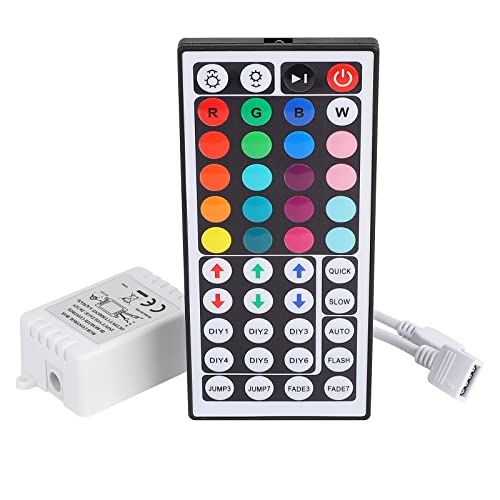
This remote offers 44 color options and five light patterns: Static, Flash, Strobe, Fade-change, and RGB Smooth-change. It’s designed for RGB strips using 4-pin connectors and is compatible with SMD 5050, 3528, and 2835 LEDs. Best for: color-rich rooms and parties where dynamic lighting is desired. Limitations: Not compatible with RGBW strips that use five pins or non-4-pin configurations.
44 Key RGB LED Light Strip Remote Controller for SMD 5050/2835/3528

Feature-rich remote with 6 DIY color keys enabling full RGB control, brightness adjustment, and on/off control. It supports 16 color options plus 5 light patterns (Static, Flash, Strobe, Fade-change, RGB Smooth-change). Best for: users who want hands-on color mixing and pattern changes from a single device. Caution: Ensure your strip uses 4-pin connectors for compatibility.
2 Pack LED Light Strip Remote Control Mini RF Wireless Controller

This RF remote supports single-color LED strips with dimming and eight dynamic modes plus speed control. It includes a memory function and works with DC 12V supplies. Best for: users who need a simple single-color dimmer with reliable out-of-box performance. Caution: Not suitable for RGB strips; this model targets single-color installations.
SUPERNIGHT RGB Light Strip Remote Controller, 2-in-1

This 2-in-1 controller enables control of two reels of RGB strips via a single remote. It offers 20 static colors and multiple modes, including Flash, Strobe, Fade, and RGB Smooth-change. Best for: setups with two separate RGB reels that require synchronized or individual control. Limitation: Works with 12V systems and four-pin RGB strips; not compatible with non-4-pin or higher-voltage strips.
SUPERNIGHT 24 Keys RGB LED Light Strip Wireless Remote Controller

Compact and budget-friendly RGB remote that supports out-of-the-box pairing with 5050, 2835, and 3528 RGB strips. It includes 16 static colors and 4 color-changing patterns (Static, Flash, Strobe, Fade-change, and RGB Smooth-change). Best for: quick replacements or additions to existing RGB setups. Caution: Correct setup requires direct line-of-sight and a standard 4-pin RGB strip.
Buying Guide: How To Choose The Right LED Strip Remote
- Connectivity and compatibility: Confirm your LED strip uses a 4-pin RGB connector and the correct voltage (commonly 12V). Some remotes only work with a single color and non-4-pin configurations.
- Color and pattern options: If you want broad color choices and dynamic effects, prioritize remotes with 16+ colors and multiple patterns (Static, Flash, Strobe, Fade, RGB Smooth-change).
- Single-color vs. RGB: For ambient lighting or simple installations, single-color dimmers can be sufficient. For vibrant colors and events, RGB remotes are more versatile.
- Distance and reliability: Look for remotes with clear line-of-sight operation and consider RF remotes for better range in larger rooms, though some models rely on IR and require direct aiming.
- Power and safety: Ensure the remote’s controller is rated for your strip’s current draw and that your power supply matches the LED strip’s voltage and amperage requirements.
- Memory and convenience features: Some remotes remember the last brightness or color setting, reducing setup time after power cycles.
Frequently Asked Questions
- What is the difference between IR and RF remotes for LED strips?
– IR remotes require line-of-sight to the receiver, while RF remotes work over a wider distance and through obstacles, depending on the model. - Can I use these remotes with any LED strip?
– Most listed remotes are designed for 4-pin RGB strips (SMD 5050/2835/3528). They are not compatible with RGBW or non-4-pin configurations unless stated. - Do these remotes require a specific power supply?
– Yes. Check the strip’s voltage (commonly 12V) and ensure the power supply can handle the total current drawn by all connected LEDs. - Is it safe to use a remote-based dimmer near electronics?
– Yes, most remotes meet standard safety certifications; follow manufacturer guidelines and keep away from water or high-heat environments. - What should I do if a remote doesn’t pair right away?
– Ensure the plastic pull tab is removed, the receiver is powered, and the remote is within range with a direct line of sight. Some remotes require re-pairing if the connection is lost. - Are two remotes better for two separate LED reels?
– If you need independent control, choose a dual-reel capable model like the 2-in-1 controller, which can manage two RGB strips from one remote.