Best Reverse Osmosis System for Aquarium Water Purity and Convenience
Answering the top question from aquarium owners: which reverse osmosis (RO) system reliably delivers true, contaminant-free water for fish tanks? This guide highlights five well-rounded RO/DI setups that balance filtration power, flow rate, and ease of use. Each model suits different buyers—new hobbyists needing simple kits, small- to mid-sized tanks, or professionals demanding high throughput. Compare features, note limitations, and decide which RO system best matches your aquarium’s needs and your maintenance preferences.
| Product | Best For | Key Benefit | Type |
|---|---|---|---|
| Aquatic Life RO Buddie 4-Stage | Beginner to intermediate tanks | Compact, affordable four-stage filtration | RO/DI |
| Aquatic Life Twist-In 4-Stage | Small to mid-sized setups | Sediment, carbon, membrane, and DI resin for up to 75 GPD | RO/DI |
| iSpring RCC1DP Tankless | Space-conscious setups needing high purity | Tankless design with 150 GPD RO membrane | RO/DI |
| Geekpure 4 Stage Portable | Apartment, RV, travel or on-the-go needs | Portable multi-stage system with DI for near-zero TDS | RO/DI |
| Aquatic Life 4-Stage 100 GPD | Mid to larger tanks with steady demand | Cartridge and DI resin with 100 GPD capacity | RO/DI |
Aquatic Life RO Buddie 4-Stage RO/DI System
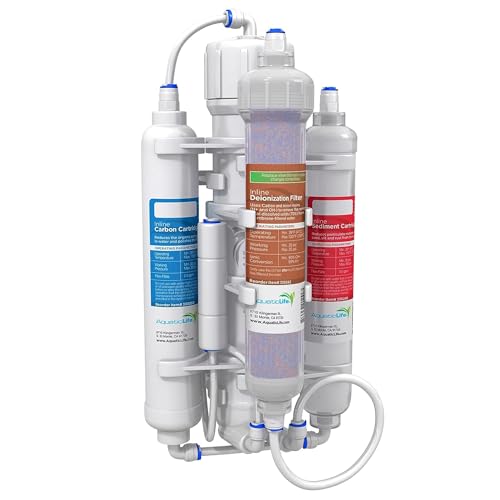
The Aquatic Life RO Buddie provides a compact four-stage filtration path to deliver clean aquarium water. It uses reverse osmosis to remove debris, with a sediment filter catching dirt and a carbon block filter reducing chlorine and odors. Best for beginner and hobbyist tanks where space is limited and a simple, reliable RO/DI setup is desired. A potential limitation is chlorine-only removal; chloramines are not addressed by this model, so additional adjustments may be needed for chloramine-treated tap water.
Aquatic Life Twist-In 4-Stage RO/DI System
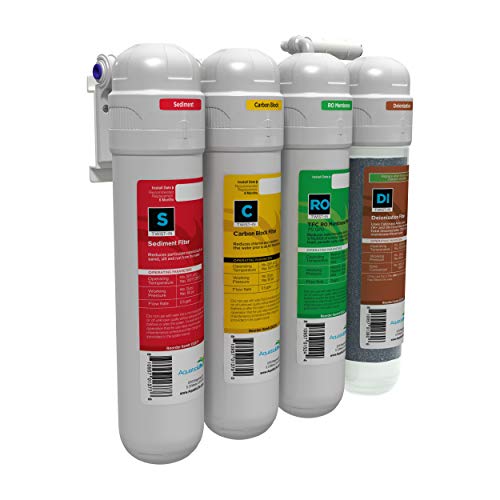
This twist-in design offers a complete four-stage filtration with sediment, carbon, RO membrane, and DI resin stages. It produces up to 75 GPD of purified water. It effectively removes dirt, rust, chlorine, and other compounds that cloud water or stress fish. Note: chloramines are not removed by this unit, so chloramine-treated tap water requires an additional step or alternative model. Best for hobbyists needing higher purity without a bulky system.
iSpring RCC1DP Tankless RO/DI System

The RCC1DP is a tankless RO/DI unit designed for space-saving installations. It features a 150 GPD membrane and pump-enhanced filtration to maintain steady performance in low-pressure environments. This model excels where high throughput matters, such as larger tanks or setups requiring rapid water changes. Limitations include its complexity and the need for careful installation, especially in compact spaces or non-standard plumbing configurations.
Geekpure 4 Stage Portable RO System

This portable four-stage system is designed for versatility, including apartment living, travel, and temporary setups. It includes a deionization stage to push TDS toward near-zero levels. It’s best for mobile or space-constrained environments where a full-length system isn’t feasible. A consideration is the need for periodic cartridge changes and ensuring proper drain management in portable installations.
Aquatic Life 4-Stage RO/DI 100 GPD
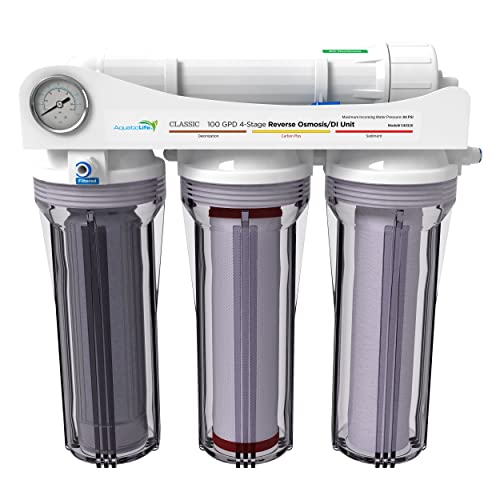
This model provides a robust 100 GPD capacity with a full RO/DI filtration train, including a carbon-plus cartridge designed to reduce chloramines and chlorine effectively. Best for mid-sized to larger tanks or aquascapes requiring dependable, ongoing purified water. A limitation is that operational costs can accumulate with DI resin replacements over time, so plan for ongoing cartridge maintenance.
Buying Guide
What should you consider when choosing an aquarium RO system?
- Water source and contaminants: Check whether your tap water contains chlorine, chloramines, nitrates, or heavy metals. If chloramines are present, ensure the system includes or works with a chloramine-removal stage or plan for post-treatment.
- Throughput needs: Estimate your weekly water-change volume. Larger tanks or community tanks benefit from higher GPD ratings (gallons per day) to reduce wait times.
- DI resin usage: DI resin polishes water to near-zero TDS. Systems with DI stages reduce long-term TDS and are preferable for sensitive livestock.
- Space and installation: Tankless or compact designs save space but may require more careful plumbing. Portable systems offer flexibility but may be less durable for permanent setups.
- Maintenance footprint: Consider cartridge and DI resin replacement frequency, availability, and overall cost of ownership.
- Filtration sequence: A typical good sequence is sediment, carbon, RO membrane, then DI resin. This order maximizes filter life and water quality.
Key comparison tips
- Best for beginners: Choose a compact four-stage RO/DI with straightforward setup and clear maintenance intervals.
- Better for high-demand tanks: Look for 150 GPD or 100 GPD systems with DI resin for optimal purity and throughput.
- Choose this if you need portability: A portable, lightweight RO system provides flexibility for apartments, travel, or temporary installations.
- Avoid this if chloramines are a concern and your water supply includes them: Select a model that explicitly removes chloramines or add a post-filter that does so.
Common FAQ
- What is RO water best used for in aquariums? – It provides clean, contaminant-free water ideal for reef tanks, freshwater fish, and plant growth by reducing dissolved solids and contaminants.
- Do all RO systems remove chloramines? – Not all do; check product notes and consider a chloramine-removal option or DI resin for post-treatment.
- How often should I replace RO filters and DI resin? – Replacement intervals vary by system and water quality; follow manufacturer guidelines and monitor TDS.
- Can a tankless RO system meet high-volume water needs? – Yes, tankless designs with high GPD membranes can maintain flow for larger tanks, but installation complexity increases.
- Is DI resin necessary for all setups? – It depends on water purity goals. DI resin offers near-zero TDS but adds ongoing replacement costs.
- What’s the advantage of a four-stage system? – A balanced setup provides sediment, chlorine reduction, membrane filtration, and final polishing with DI resin for high-purity water.