Best Thermal Cyclers for PCR: Top Picks for Labs, Schools and Field Work
Looking for a reliable thermal cycler for PCR? This guide highlights five top options that balance accuracy, speed, and ease of use. Ideal for researchers, educators, and field technicians, these picks cover compact benches, high-throughput needs, and standalone operation without a PC. Each product includes a quick “best for” note and a potential limitation to help you compare at a glance.
| Product | Capacity | Best For | Notes |
|---|---|---|---|
| Edvotek EdvoCycler Jr. PCR Machine | 16 x 0.2 mL | Small labs and teaching labs | Standalone, 7″ touchscreen |
| Mini Thermal Cycler – ULTRAVEN MTC‑16 | 16 x 0.2 mL | Portable, field-ready setups | Very compact, fast cycling |
| Edvotek EdvoCycler 2 | 48 x 0.2 mL + 8-tube strip | Higher throughput in a compact form | Real-time data, active cooling |
| Eppendorf Mastercycler Gradient | Various: 25 x 0.2 mL, 16 x 0.5 mL, or 96-well plate | Gradient PCR, precision experiments | Advanced temperature control |
| NEWTRY Gradient Thermal Cycler PR-96E | 96-well format | High-throughput diagnostics and education | Built-in gradient calculator |
Edvotek EdvoCycler Jr. PCR Machine
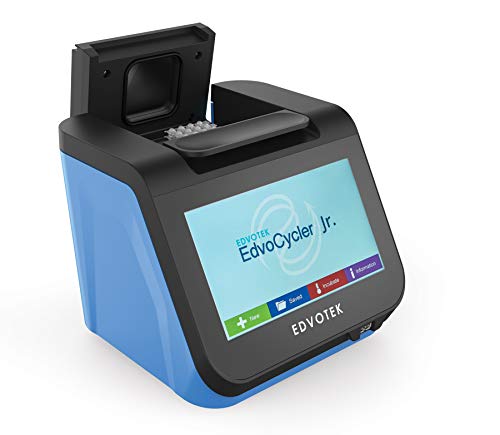
The Edvotek EdvoCycler Jr. offers 16 x 0.2 ml tube capacity with compatibility for an 8-tube strip. It features a 7-inch HD color touchscreen and operates as a standalone device, without requiring a PC or smartphone. This makes it suitable for teaching labs, clinics, and small research settings where simplicity and visibility of run data are important.
Best for: small teaching labs and researchers who value an easy, standalone workflow with direct real-time monitoring. It is a solid choice when you need clear on-device data display and straightforward operation.
Caution: While excellent for basic and educational use, this model may have limited throughput compared to higher-capacity systems and may lack some advanced programming features found in larger units.
Mini Thermal Cycler, ULTRAVEN MTC‑16
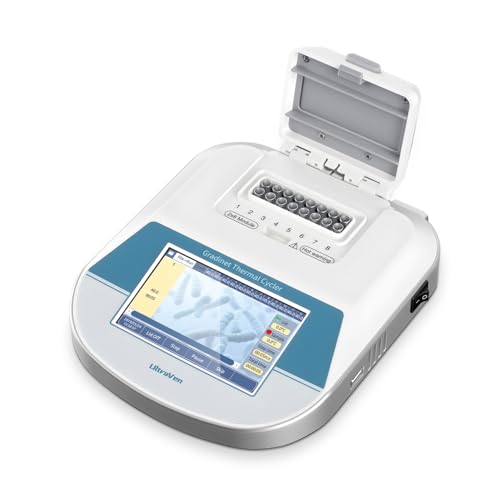
ULTRAVEN’s MTC‑16 is a compact, portable cycler weighing around 3.2 kg with fast cycling speeds and precise control. It supports quick ramping and uniform temperatures, making it suitable for field work, point-of-care labs, or small bench setups where space is at a premium.
Best for: field technicians and mobile labs needing a lightweight, fast cycling option that still maintains temperature accuracy.
Caution: Very compact units can have fewer advanced programming options; verify software capabilities align with your assay needs before purchase.
Edvotek EdvoCycler 2 Thermal Cycler

The EdvoCycler 2 expands capacity to 48 x 0.2 mL tubes plus an 8-tube strip, with a 7″ HD touchscreen for real-time data visualization. It also includes active cooling to maintain low temperatures, which can improve assay consistency during longer runs.
Best for: researchers and educators needing higher throughput without moving to a fully professional-grade system. It balances capacity with a familiar Edvotek interface.
Caution: Throughput increases may come with added power requirements and a larger footprint than basic portable models.
Eppendorf Mastercycler Gradient PCR Thermal Cycler

The Mastercycler Gradient provides gradient temperature control with extremely rapid temperature changes, supporting 4 to 99°C. It accommodates various formats, from 25 x 0.2 mL tubes to 96-well plates, and is designed for precision and flexibility in demanding experiments.
Best for: labs requiring precise gradient PCR and flexible format support for diverse assay designs. This is a strong choice where gradient optimization and rapid cycling are essential.
Caution: Higher-end features come with a premium price and potentially steeper learning curve for new users.
NEWTRY Gradient Thermal Cycler PR-96E

The PR-96E supports a 96-well format with a built-in gradient calculator that shows temperature distribution in real time. It emphasizes precise annealing temperatures through uniform sensor distribution and a flexible thermal lid to accommodate varying tube heights.
Best for: high-throughput labs and academic programs needing accurate gradient optimization and a versatile lid system. Choose this if you require reliable uniformity across a large plate format.
Caution: Gradients and high-throughput capability may require more maintenance and calibration to sustain peak performance.
Buying Guide
Key considerations when selecting a thermal cycler for PCR include throughput needs, footprint, and standalone versus PC-connected operation.
- Throughput vs. bench space: If you run many samples, prioritize higher capacity (e.g., 48 x 0.2 mL or 96-well formats) but ensure your bench can accommodate the unit.
- Control and programming: Look for gradient capability, multi-channel options, and user-friendly interfaces. Real-time data display helps monitor experiments without external equipment.
- Portability: For field work, compact and lightweight designs with fast ramp rates offer practical benefits.
- Power and connectivity: Standalone units reduce dependencies on computers; some workflows may still benefit from PC or smartphone integration.
- Maintenance and calibration: Consider ease of calibration, service availability, and whether the manufacturer provides regular software updates.
FAQ
- What is a gradient PCR thermal cycler?
A gradient cycler allows testing multiple annealing temperatures in a single run to optimize PCR conditions, improving primer specificity and yield.
- Do I need real-time data on a PCR machine?
Real-time data helps monitor amplification progress and confirm results without additional equipment; it’s especially useful in teaching labs and clinical settings.
- Which capacity should I choose for teaching labs?
16 x 0.2 mL is sufficient for small classes, while 48 x 0.2 mL or 96-well formats suit larger groups and higher-throughput experiments.
- Is a standalone thermal cycler better than one that requires a PC?
Standalones are easier to deploy in spaces with limited IT support, but PC-connected models can offer expanded programming and data management options.
- What maintenance should I expect?
Regular calibration, lid pressure checks, and software updates help maintain accuracy and consistency across runs.