Best USB Oscilloscope for PC: Top 5 Picks for DIYers and Professionals
Looking for a reliable USB oscilloscope that works with a PC? This guide highlights five strong options, each suited to different user needs—from portable handheld models to full-featured PC-connected scopes. Best for students and hobbyists who need portability, or for engineers who require more channels and deeper memory, these selections balance usability with essential measurement capabilities. Below, you’ll find product-by-product comparisons, plus a Buying Guide and quick FAQs to help you decide.
Product Comparison Snapshot
| Product | Best For | |
|---|---|---|
| Hantek 1008C+HT201+HT30A+HT307 PC USB 8CH | Comprehensive automotive diagnostics and multi-channel measurements | 8 analogue channels, 12-bit resolution, 4K memory, 2.4 MSa/s |
| FNIRSI DSO152 Handheld | Portable, budget-friendly basic testing | 2.5 MS/s, 200 kHz bandwidth, 2.8″ display |
| EspoTek Labrador | Open-source, all-in-one tool with multiple functions | 2-channel oscilloscope, 2 MSPS per channel, 4.5V–15V power |
| Hantek 1008C PC USB 8CH | Versatile PC-based diagnostic scope | 8 channels, automotive diagnostics, 12-bit |
| FNIRSI 2C53T | 2-in-1 oscilloscope and multimeter for professionals | 50 MHz, 250 MS/s, 19999 counts |
Hantek 1008C+HT201+HT30A+HT307 PC USB 8CH Automotive Diagnostic Scope
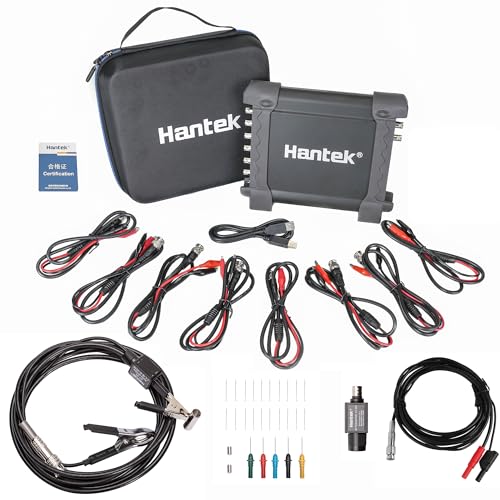
The Hantek 1008C family combines automotive diagnostics with a multi-channel general-purpose oscilloscope and a programmable signal generator. It supports 8 analogue channels, 12-bit resolution, and a 4K memory depth. Real-time sampling reaches 2.4 MSa/s, with 20 automatic measurement modes accessible at the push of a button. This model is best for automotive technicians and engineers who need to diagnose vehicle systems while also capturing complex electrical signals with a single device. A notable caution is that advanced features rely on the bundled software and proper configuration for automotive tests.
Hantek 1008C PC USB 8CH Automotive Diagnostic Digital Oscilloscope

Designed for PC-based operation, this Hantek model emphasizes automotive diagnostic functions alongside standard oscilloscope capabilities. Its 8 analogue channels and 20 automatic measurement modes simplify quick signal analysis, making it a solid pick for automotive technicians who need a versatile, PC-connected instrument. Best for users who want robust automotive testing in combination with general-purpose waveform capture. Limitation: the interface and features may require familiarity with Hantek’s software ecosystem to maximize value.
FNIRSI DSO152 Handheld Oscilloscope

This handheld scope offers portability with a 2.8″ LCD and a 2.5 MS/s sampling rate, sufficient for quick field diagnostics. With a bandwidth of 200 kHz and a probe rated up to 800 VPP, it suits hobbyists and field technicians working on low- to moderate-voltage signals. Choose this if you need a compact, self-contained unit for quick checks and basic waveform observation. A limitation is its smaller display and lower bandwidth compared to PC-connected models.
EspoTek Labrador: Open-Source USB Oscilloscope

The Labrador is an open-source, all-in-one USB device offering a two-channel oscilloscope, a two-channel arbitrary waveform generator, and a small power supply. It also functions as a logic analyzer and a multimeter when combined with compatible software. Best for developers and educators who want an affordable, programmable tool with software flexibility across Windows, Mac, Linux, and more. Better for learning and experimentation than for high-speed professional testing. Limitation: performance is lower than dedicated high-bandwidth benchtop scopes.
FNIRSI 2C53T Upgraded Handheld Oscilloscope

The 2C53T upgrades previous models with math operations, cursor measurement, persistence and XY modes. It’s a two-channel oscilloscope with 50 MHz bandwidth and 250 MS/s sampling, plus a four-and-a-half digit multimeter that covers a wide range of measurements up to 400 V. This model suits professionals who need a portable PC-like testing experience with enhanced measurement features. Caution: as a handheld device, it may require careful handling in busy work environments to avoid signal interference.
Hantek 6022BE Digital Oscilloscope Portable PC Based 2 Channels

This portable two-channel oscilloscope connects to a PC via USB and provides 20 MHz bandwidth with USB 2.0 power, making it easy to use without a separate power supply. It offers 23 measurement functions and PASS/FAIL checks, aimed at technicians and students who need a straightforward, PC-based testing solution. Best for education and routine diagnostics where simple waveform capture is sufficient. Limitation: lower bandwidth compared to higher-end models, which may affect fast signal capture.
Buying Guide: What to Look For In A USB Oscilloscope For PC
- Bandwidth and sampling rate: Higher bandwidth and sampling rates enable more accurate waveform capture, especially at higher frequencies. Choose according to the signals you plan to measure.
- Channel count: More channels allow simultaneous observation of multiple signals. Consider if you need 2-channel or 8-channel capability for your projects.
- Memory depth: Deeper memory helps with long acquisitions and more detailed analysis. If you are analyzing long periods, prioritize models with larger memory.
- Software compatibility: Ensure the device supports your operating system and preferred software ecosystem (Windows, macOS, Linux, etc.). Open-source options provide flexibility for advanced users.
- Portability vs. bench use: Handheld devices excel in the field; PC-based scopes are typically more powerful for in-depth analysis but sit on a desk.
- Auto-measurement and triggers: Look for auto measurement modes and trigger options (Auto/Normal/Single) to simplify data capture and interpretation.
- Power and connectivity: USB-powered devices are convenient for laptops; confirm compatible USB standards and voltage requirements.
FAQs
- What is a USB oscilloscope for PC?
A USB oscilloscope connects to a computer via USB and uses PC software to display, measure, and analyze waveforms. It combines portable hardware with flexible software-driven tools.
- Do I need software to use a USB oscilloscope?
Yes. Most USB scopes rely on companion software for waveform display, measurements, and data export. Some models support open-source software options.
- Is higher bandwidth always better?
Higher bandwidth enables accurate capture of faster signals. For simple voltage measurements or low-frequency signals, lower bandwidth can suffice and reduce system requirements.
- Are portable handheld scopes good for professional work?
They’re ideal for field diagnostics and quick checks, but bench-top PC scopes generally offer more features, stability, and memory for detailed analysis.
- Can I use these scopes with multiple operating systems?
Many models support Windows, and some offer compatibility with macOS, Linux, or Android through specific software or drivers. Check each product’s documentation for compatibility details.