Best Wearable Microphones for Teachers: Clear Voices in Classrooms and Tours
The best wearable microphone systems for teachers are chosen to boost clarity, reduce throat strain, and keep presenters mobile. This guide highlights five reliable options, each suited to different classroom sizes, teaching styles, and budgets. Use this to choose a sound system that fits long lecture hours, group activities, or outdoor tours. The top picks emphasize easy setup, strong battery life, and comfortable wear for everyday use.
| Product | Best For | Key Benefit |
|---|---|---|
| ZOWEETEK ZW-Z258 | Large classrooms and tours | High maximum output and belt/waistwear options |
| SHIDU M500 | Long sessions with wireless mic | Long-range wireless with Bluetooth music playback |
| WinBridge WB002 | Public speaking and teaching | All-day wear with long battery and easy pairing |
| VOVIGGOL Portable | Compact teaching setups | Small, powerful and MP3 playback |
| Norwii 2000mAh | Budget-friendly classrooms | Clear sound with feedback suppression |
ZOWEETEK ZW-Z258 Portable Voice Amplifier

Best for teachers who need loud, clean voice amplification in medium-to-large rooms. The ZW-Z258 delivers up to 10 watts, covering about 10,000 square feet, making it suitable for classrooms, training sessions, and guided tours. Its compact size and belt or waist attachment options support flexible use during lectures and activities. The model emphasizes crisp sound with minimal noise or distortion, which is crucial for clear instruction and student engagement.
Who it’s best for: teachers who want a simple, portable system without a wireless microphone, and tutors who frequently move around the room. Why selected: strong audible reach and ease of use with a secure belt clip. Limitation: built-in microphone options may rely on wired connections, which can limit mobility compared to full wireless kits.
SHIDU M500 35W Power Voice Amplifier

Best for large classrooms or training events where a robust wireless system is essential. The M500 pairs a 2.4G lavalier microphone with a 35W amplifier, delivering strong coverage (estimated up to 22,604 square feet / 2100 square meters) and reliable wireless performance. It supports music playback via Bluetooth and is designed to minimize ear fatigue while maintaining clear voice projection.
Who it’s best for: teachers or trainers who host big groups and need dependable wireless performance with extended range. Why selected: high output and wireless stability, plus music playback capability. Limitation: heavier setup compared with ultra-compact units; may require careful placement for optimal coverage.
WinBridge WB002 Bluetooth Voice Amplifier

Best for teachers who value a balanced, all-in-one wireless solution with a long battery life. The WB002 provides a 15W output, covering up to 10,000 square feet, and includes a portable headset microphone system designed for classroom mobility. The unit emphasizes ease of setup and automatic pairing for quick activation at the start of class.
Who it’s best for: middle- and high-school instructors needing a reliable, mid-range amplifier with a comfortable headset option. Why selected: strong battery life (up to 12-15 hours) and practical wireless pairing. Limitation: headset mic may feel less comfortable for some users over extended periods compared with clip-on mics.
VOVIGGOL Portable Voice Amplifier with MP3 Playback

Best for teachers who want a compact unit with multimedia capabilities. The VOVIGGOL model has an 8W output, supports MP3 playback via TF card or USB drive, and includes a clip-on headset microphone. It’s suitable for smaller rooms, outdoor tours, and presentations where background music or audio examples are part of the lesson.
Who it’s best for: teachers who need quick playback of pre-recorded audio or music as part of lessons. Why selected: multifunctional featuring MP3 playback and wired options. Limitation: lower amplification than larger 15–35W units, which may be noticeable in very large spaces.
Norwii Bluetooth Voice Amplifier
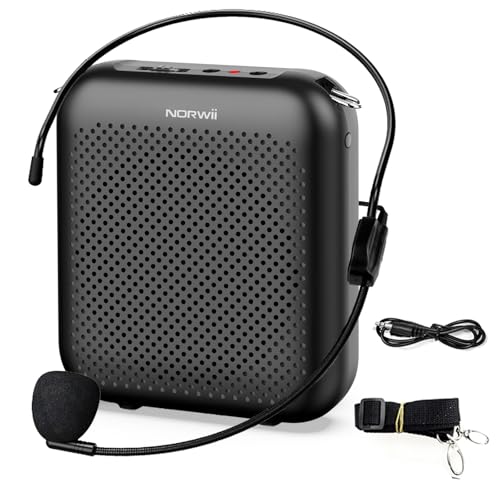
Best for educators on a budget who still need clear amplification and feedback suppression. The Norwii unit offers 10W output with a headset mic and USB-C charging. It emphasizes a lightweight design and a boosted signal to extend listening range while minimizing feedback through frequency shifting technology.
Who it’s best for: teachers seeking affordable reliability with a simple wired mic option and clear voice projection. Why selected: compact, budget-friendly choice with practical anti-feedback features. Limitation: not as feature-rich as higher-widelity models or those with extended battery life.
WinBridge WB005N Wireless Voice Amplifier

Best for educators who prefer a clip-on lavalier mic and a portable speaker without a headset. The WB005N emphasizes lightweight design, full day wear, and automatic pairing for straightforward classroom deployment. It’s suitable for teachers who move between stations or outdoor activities where mobility is essential.
Who it’s best for: teachers who want a discreet, hands-free solution with reliable amplification. Why selected: ultra-light clip mic and simple operation. Limitation: some users may prefer a headset for more stable long-range audio during active lessons.
HW HAOWORKS A006 Voice Amplifier

Best for teaching environments that require flexible movement and reliable audio with a long wireless range. A006 delivers up to 15 meters (49 feet) of wireless coupling with a clip-on lapel mic and a compact design. It includes thoughtful controls for mute and volume, making it easy to adapt during live classroom sessions.
Who it’s best for: teachers who want a compact solution with a comfortable microphone and straightforward setup. Why selected: good balance of range, portability, and ease of use. Limitation: battery life varies by usage and may require periodic charging during long days.
Buying Guide: Key Considerations for Choosing a Wearable Microphone System
- Room size and audience: For larger classrooms or tour groups, prioritize higher wattage and longer-range wireless systems.
- Microphone type: Clip-on lavalier mics are common and comfortable for long sessions; headsets can offer steadier sound during active movement.
- Battery life: Look for devices with long runtimes and quick charging; teachers often spend full days teaching without frequent recharges.
- Connectivity: Bluetooth and 2.4G wireless options provide different benefits. Bluetooth is simple, while 2.4G often yields lower latency and stable connections in busy environments.
- Audio features: Noise reduction, anti-feedback tech, and the ability to play MP3s or music can enhance lesson delivery and engagement.
- Portability: Weight, clip design, and body-welt compatibility influence comfort during extended classes.
- Setup and maintenance: Favor units with auto-pairing, straightforward controls, and easy charging options for back-to-back lessons.
Frequently Asked Questions
- What should I consider first when buying a teacher wearable microphone?
– Consider room size, whether you need wired or wireless mics, and how long you’ll use the device daily. - Is a headset mic better than a clip-on mic for teaching?
– Clip-on mics are lighter and less obtrusive; headset mics can offer steadier sound during active teaching but may be less comfortable for long sessions. - What is a typical battery life for classroom use?
– Many units provide 8–15 hours of amplification, with some models offering longer usage with a single charge. - Do I need Bluetooth if I already have a wireless system?
– Bluetooth is convenient for simple setups, while 2.4G systems can be more stable in crowded wireless environments. - Can these devices play music or audio besides voice?
– Several models support MP3 playback or Bluetooth music streaming, which can be useful for lessons with multimedia elements. - Are these systems easy to set up for first-time users?
– Most listed options emphasize quick setup, automatic pairing, and simple controls suitable for teachers new to amplification tech.