Best Wind Turbine Kits for Students: Hands-on Learning With Real-World Power
Yes—these wind turbine kits help students understand renewable energy by building working models. They’re ideal for classrooms, science fairs, or DIY learning at home. This guide highlights five kits that balance hands-on exploration with clear, teachable concepts, from small indoor experiments to more robust outdoor projects. The best picks are suited for middle and high school students, educators planning demonstrations, and ambitious hobbyists seeking practical wind-power basics.
| Product | Best For | Why It Stands Out |
|---|---|---|
| Thames & Kosmos Wind Power V5.0 | Hands-on energy experiments | Updated design, indoor/outdoor use, clear energy concepts |
| EUDAX 6 Set Mini Generator Motors | Modular electronics practice | Multi-volt, modular parts for diverse experiments |
| Thames & Kosmos Wind Power V4.0 | Weatherproof outdoor education | Real 3-foot turbine with charging capability |
| Uncedaran Vertical Axis Wind Turbine Kit | Vertical-axis concepts | Self-assembly, practical hands-on operation |
| QINIZX Small Wind Turbine Kit | Classroom demonstrations with fans | Low-cost, approachable for large groups |
Thames & Kosmos Wind Power V5.0 STEM Experiment Kit

The Thames & Kosmos Wind Power V5.0 is best for students who want an upgraded, versatile wind turbine project. It includes a 3-foot-tall model and is optimized for both indoor and outdoor use, making it suitable for classrooms and science fairs. The kit emphasizes the technology behind wind energy and practical applications, helping learners see how blade design and gearing affect performance.
Best for: middle-to-high school learners and educators seeking a durable, expandable wind energy experience. Why selected: its fifth-generation design updates blade hub and gear ratio for better results in varied wind conditions, while remaining accessible for guided lessons. Caution: assembly complexity is higher than entry-level kits, so plan time for setup and teacher-led demonstrations.
EUDAX 6 Set Mini Generator Motors

The EUDAX 6 Set Mini Generator Motors package is ideal for students who want modular experimentation with multiple voltages and configurations. This kit includes several motors, brackets, propellers, LEDs, and a straightforward manual, supporting a range of wind, solar, and mechanical power experiments.
Best for: beginners and advanced learners who want to mix wind-driven and other power sources in a single project. Why selected: it provides multiple voltage options and a hands-on way to explore how changes in speed, gear ratio, or propulsion affect current. Caution: data shows diverse parts; organization is essential to maintain consistent experiments and safe connections.
QINIZX Small Wind Turbine Kit

The QINIZX kit is a compact option designed for demonstrations and personal projects. It emphasizes a larger blade area and a clear linkage between wind power and electricity generation, though it requires a fan or blower to provide wind. Best for: classroom demos where a visible turbine helps explain power conversion. Why selected: the kit’s larger blades produce noticeable outputs under controlled air flow, aiding comprehension. Caution: not suitable for natural wind environments; requires a powered fan for effective demonstration, and is not a toy for young children.
Thames & Kosmos Wind Power V4.0 STEM Experiment Kit
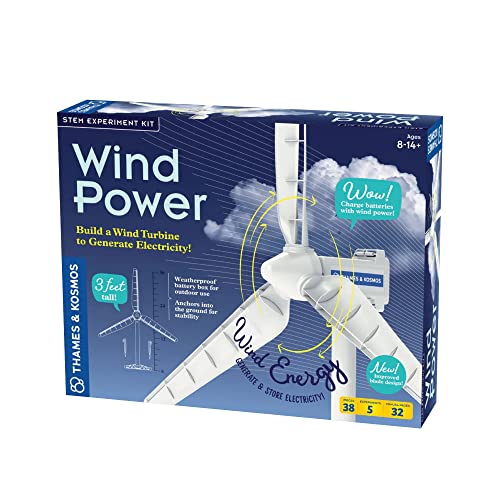
The Wind Power V4.0 kit is a solid choice for outdoor-oriented learning. It features a real 3-foot wind turbine with single-piece blade construction for durability and improved aerodynamics. The kit demonstrates how wind energy can generate electricity to charge a battery and power a small model car, making the concept tangible for students.
Best for: outdoor science lessons and steady demonstrations of wind-to-electricity conversion. Why selected: the weatherproof design and real turbine model help illustrate practical energy transfer. Caution: older versions may lack some of the latest optimizations found in V5.0, so pair with a structured lesson plan to maximize learning outcomes.
Uncedaran Vertical Axis Wind Turbine Kit

The Uncedaran Vertical Axis Wind Turbine Kit offers a different perspective by focusing on vertical-axis turbine concepts. It emphasizes self-assembly and practical operation as an educational tool to explore how turbine orientation affects efficiency.
Best for: learners exploring alternative turbine designs and hands-on construction. Why selected: the vertical-axis approach broadens understanding beyond traditional horizontal-axis models. Caution: may require more careful alignment and calibration to demonstrate consistent outputs, especially for larger wind sources.
Buying Guide
What should you look for in a student wind turbine kit?
- Learning objectives: Choose a kit aligned with your curriculum goals, whether it’s basic energy conversion, blade design, or system integration with batteries and chargers.
- Wind source compatibility: For indoor demos, confirm the kit can use a fan or blower. Outdoor kits should withstand weather and include a durable power path.
- Durability and assembly effort: For younger students, look for simpler assembly and more guided activities. For older students, pick kits with modular parts and expandable experiments.
- Measurement and data: Section the kit with ways to measure voltage, current, and power, so students can quantify performance and compare designs.
- Safety and best practices: Ensure components avoid exposed wiring during classroom demonstrations and that assembly notes emphasize safe handling.
Versus: What’s Best For Your Setting?
If you’re teaching a broad group, a kit with clear, teachable energy concepts and robust outdoor capability (like the Wind Power V4.0) can support many activities. For labs focused on electronics, the EUDAX set’s multiple voltages and modular components offer flexible experiments. For demonstrations requiring a visible turbine model, the Thames & Kosmos V5.0 provides a modern, optimized design. If you want a different turbine geometry, the Uncedaran kit introduces vertical-axis concepts to broaden understanding. Finally, the QINIZX kit is suited to quick classroom demos when you have access to a controlled air source but must manage expectations about natural wind use.
Practical Tips
- Plan a lesson sequence: start with a simple wind-to-electricity idea, then introduce variables such as blade design, gearing, and wind speed.
- Prepare data sheets: have students record wind speed (when possible), voltage, and current, then calculate power output.
- Include safety briefing: remind students about electrical connections, battery handling, and keeping hands clear of spinning parts during tests.
FAQ
- Do these kits require natural wind to work? Some do, some don’t. Indoor-friendly kits can run on a powered fan; outdoor-focused kits can use real wind.
- Are these kits suitable for younger children? Many are designed for ages 8+, but some may require adult supervision or teacher-led guidance.
- Can these kits teach energy concepts beyond electricity? Yes. They’re useful for lessons on renewable energy, power generation, and engineering design principles.
- Do they come with measurement tools? Several kits include LEDs, meters, or simple indicators to visualize output, while others may require additional measuring equipment.
- Are there alternatives for vertical-axis concepts? Yes—the Uncedaran kit specifically explores vertical-axis turbine ideas.