Best Freeze Spray for Electronics: Quick Cooling for Troubleshooting and Testing
Answering the common need for fast, non-conductive cooling of electronic components, this guide compares top freeze sprays ideal for diagnostics, soldering prep, and component testing. Best for technicians who need targeted cooling at the component level, or hobbyists validating heat-related failures. The table below highlights five strong options with clear outcomes for different scenarios.
| Product | Best For |
|---|---|
| Vaxxen Labs Instant Freeze Chilling Spray | Fast cooling to ultra-low temps; small, targeted areas |
| WEICON Freeze Spray | Field troubleshooting and sensor testing |
| Xtreme Heaters Instant Freeze | Industrial or professional testing of heaters and electronics |
| Techspray 1672-10S High Precision Diagnostic Freeze Spray | Precise diagnostics on capacitors, resistors, semiconductors |
| Techspray 1672-10S Envi-Ro-Tech Freeze Spray | Alternating two-pack reliability checks and boards |
Vaxxen Labs Instant Freeze Chilling Spray

The Vaxxen Labs Instant Freeze Chilling Spray is a fast-acting solution designed to chill down to ultra-low temperatures quickly. It is made in the USA and is positioned for professional use. Best for technicians who need rapid, focused cooling on small components. A potential limitation is that ultra-low temperatures may require careful handling to avoid thermal shock of sensitive parts.
WEICON Freeze Spray
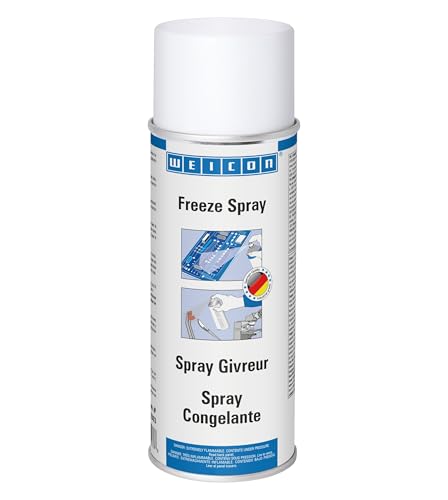
WEICON Freeze Spray provides targeted cooling to about -45°C (-49°F). It’s versatile for field troubleshooting and sensor testing, and it’s non-conductive, making it suitable for many electronics applications. Best for on-site technicians and shop setups where quick checks of mounted components are needed. Limitation: plant-wide cooling is not possible; it’s best for localized areas.
Xtreme Heaters Instant Freeze
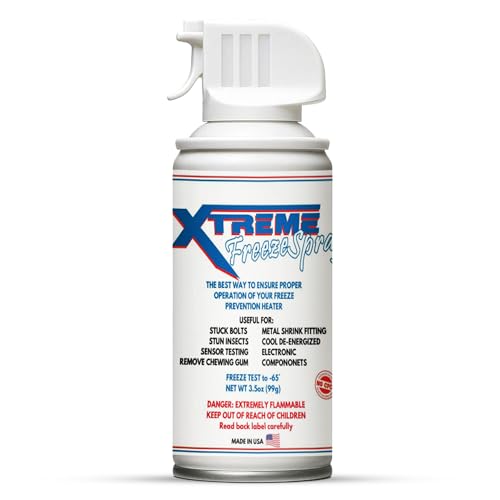
Xtreme Heaters Instant Freeze offers a professional-strength spray for rapid cooling of electronics, mechanical parts, and craft projects. It’s designed for industrial and technical use, enabling quick activation of heaters or verification of thermal response. Best for professionals needing repeatable cooling cycles. Caution: stronger formula may be more aggressive on delicate plastics; test on a small area first.
Techspray 1672-10S High Precision Diagnostic Freeze Spray

This Techspray product aims at high-precision diagnostics for intermittently faulting capacitors, resistors, semiconductors, and other components. It increases visibility for cold joints and thermal cracks, aiding troubleshooting in electronics production and repair environments. Best for technicians needing clean, controlled cooling for precise inspection. Limitation: contains specific refrigerant formulations; ensure compatibility with tested materials.
Techspray 1672-10S Envi-Ro-Tech Freeze Spray

The Envi-Ro-Tech variant is noted for utility in everyday electronics troubleshooting. It is made in the United States and designed to facilitate quick, nonflammable cooling for board-level diagnostics. Best for shop environments that need a reliable two-pack option. Caution: ensure proper ventilation when using near heat sources.
Buying Guide
Key considerations when choosing a freeze spray for electronics include cooling capacity, non-conductivity, safe use on plastics and boards, and the intended environment (lab, field, or workshop). For precise diagnostics, prioritize high-precision options like Techspray’s Envi-Ro-Tech and High Precision variants. If you need ultra-fast, localized cooling, products like Vaxxen Labs and Xtreme Heaters are strong contenders. When testing sensors or mounted components, non-conductivity and material compatibility are essential. Consider pack size and refill availability for ongoing workflows.
What cold temperature matters for electronics?
Lower temperatures help reveal cold solder joints, cracked components, or intermittent faults. However, extremely low temps can stress plastics and adhesives. Choose a product that provides sufficient cooling without risking damage to your specific components.
How to use freeze spray safely?
Apply in short bursts to avoid thermal shock. Keep sprays away from open flames and always use in a well-ventilated area. Test on a small, non-critical area first to verify compatibility with materials and coatings.
What to consider for field troubleshooting?
Non-conductivity, portability, and ease of use are crucial. WEICON Freeze Spray and similar field-friendly options are designed for quick diagnostics away from the bench, while professional-grade sprays suit shop environments with controlled conditions.
Are there eco-friendly or US-made options?
Several products on this list are manufactured in the United States and emphasize professional-grade formulations. If regional availability matters, confirm current production details from the seller, as formulations and packaging can change over time.
How to compare two-pack versus single-pack sprays?
Two-pack options can be advantageous for regular maintenance or high-volume labs, ensuring consistent availability. For occasional use, single packs may suffice, but verify shelf stability and refills when budgeting.
FAQ
- What is the best freeze spray for cooling electronics quickly? — For ultra-fast, targeted cooling, products like Vaxxen Labs Instant Freeze and Xtreme Heaters Instant Freeze are strong choices.
- Is freeze spray safe on all plastics? — Not all sprays are equally safe for every plastic; opt for non-conductive, electronics-approved formulations and test on a small area first.
- Can freeze spray reveal solder joint issues? — Yes. Some sprays enhance visibility of cold solder joints and micro-cracks, aiding inspection.
- Should I use freeze spray in a professional shop or on-site? — Both are possible; WEICON and similar field-friendly sprays are designed for on-site troubleshooting, while Techspray variants are optimized for precision lab work.
- Do these products comply with environmental or safety standards? — Many options are non-flammable and designed for electronics use; always follow the manufacturer’s safety data sheets and local regulations.
- Do I need multiple sprays for different tasks? — A combination approach works well: high-precision sprays for diagnostics and field-friendly sprays for quick checks.