Best ASIC Miners for Bitcoin Mining in 2026: Efficient Options for Home and Small-Business Setups
Answering the buyer’s search intent: these ASIC miners represent efficient, plug-and-play options for Bitcoin mining at home or in small offices. The best picks balance hash rate with energy use, noise, and ease of setup. This guide highlights five models that suit different budgets and environments, from quiet home use to higher-capacity setups. Each product is evaluated for target buyers, strengths, and a practical caveat to consider before purchasing.
| Product | Hashrate | Power | Best For |
|---|---|---|---|
| Avalon Q 90TH/s | 90 TH/s | 18.6 J/TH | Home miners seeking efficiency |
| Antminer S19pro 100TH/S | 100 TH/s | 33 J/TH | Medium to large setups |
| Canaan Avalon Nano 3S | 6 TH/s | 140 W | Quiet, office-friendly mining |
| Bitaxe Gamma 602 | 1.8 TH/s | 35 W | Low-noise, desktop mining |
| Bitforge Nano | Up to 2.5 TH | 12 V system | Open-source hobby mining |
Avalon Q 90TH/s Bitcoin Miner

The Avalon Q 90TH/s miner targets home and small-business users who want high efficiency with a lower energy footprint. It delivers 90 TH/s while consuming around 18.6 J/TH, making it among the more energy-efficient options in this price class. It ships with a power cord suitable for standard outlets, simplifying setup for users with basic electrical readiness.
Best for: Home miners who want strong performance without a large energy bill. Better for users who value out-of-the-box reliability from a trusted seller. Limitation: Real-world profits depend on stable electricity costs and pool conditions; higher power can still impact long-term operating expenses.
Key points:
- Out-of-the-box readiness with original New Canaan Avalon components
- 180–240V operability for flexible installation
- Manufacturing warranty reference; ensure current seller terms at purchase
POWER MINING Bitaxe Gamma 602
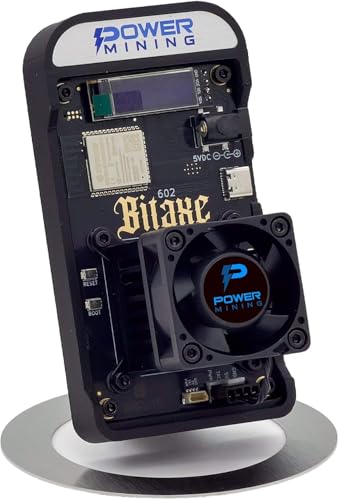
The Bitaxe Gamma 602 offers a compact, Europe-built solution with 1.1 TH/s at 18W per TH (18W total ~1.1 TH/s), and BM1370 ASIC chips similar to professional-grade devices. This makes it a practical choice for small offices or homes seeking a quieter, energy-conscious mining option. It includes a power supply and stand for easier setup.
Best for: European buyers or anyone prioritizing ultra-low energy use and a compact footprint. Better for: Beginners exploring solo mining without large power costs. Caution: At this scale, you’ll want reliable cooling and stable network access to avoid throttling in sustained runs.
Key points:
- Open-source firmware friendly with 2.4G Wi-Fi or Ethernet
- Quiet desktop design suitable for living spaces
- Open-source ecosystem support for tweaks and pool connections
YYSLUPING 601 Bitcoin Miner

The YYSLUPING 601 operates between 1 and 1.2 TH/s with BM1370 ASIC chips at an energy efficiency of 15–16 J/TH, drawing roughly 18–20W. Its open-source AxeOS and OLED display provide transparency and real-time status visibility, while open-source firmware supports customization.
Best for: Beginners seeking straightforward solo mining with an educational angle. Better for: Quiet home setups and learners who want to experiment with open-source firmware. Caution: Lower hash rate means longer payback periods in fluctuating Bitcoin markets.
Key points:
- 2.4G Wi-Fi and OLED readout for live status
- Open-source firmware ecosystem
- Designed for home environments with compact form
Canaan Avalon Nano 3S BTC Miner

The Avalon Nano 3S is a compact 6 TH/s miner operating at about 140W. It targets quiet operation and suitability for office or home use, with a built-in power supply and a focus on energy efficiency. The model supports solo mining and stake pool arrangements for flexibility.
Best for: Quiet environments where consistent, manageable power use matters. Better for: Small offices or homes needing a balance of performance and noise. Caution: With 6 TH/s, it’s not designed for high-volume industrial mining; expect slower payback versus larger rigs.
Key points:
- Low 140W power envelope for efficiency
- Quiet operation suitable for shared spaces
- Original power supply included for easier setup
Buying Guide: How To Choose The Right ASIC Miner For Bitcoin
What image of a miner matches your needs? Consider hash rate, power efficiency, noise, setup complexity, and long-term operating costs. For home users, aim for models with lower noise and good energy efficiency. For small businesses, prioritize higher hash rates and stable electricity availability.
Key questions to answer:
- What is the total available power in your space, and can you sustain continuous operation?
- Do you prefer plug-and-play or are you comfortable with open-source firmware and tweaks?
- Is noise a critical factor due to a shared living or working space?
- Is the focus on initial investment, or long-term operating costs and energy efficiency?
Power and Space Considerations
Hash rate is important, but total energy consumption determines profitability. Lower J/TH figures reduce electricity costs. Also ensure adequate cooling and airflow to prevent thermal throttling and hardware wear.
Open-Source vs. Proprietary Firmware
Open-source options provide flexibility and ongoing updates but may require more technical involvement. Proprietary firmware tends to offer straightforward operation and polished pool integration out of the box.
Reliability And Support
Look for models with active seller support and, where possible, a clear warranty or return policy. Real-world uptime depends on stable power, cooling, and internet connectivity.
Open-Source Community And Compatibility
Open-source miners can join communities for firmware improvements and troubleshooting. Confirm compatibility with your preferred mining pools and network settings before purchase.
Implementation Checklist
Before buying:
- Confirm electrical capacity and outlet compatibility
- Plan for ventilation or cooling solutions
- Decide on pool vs. solo mining approach
- Prepare network access and wallet addresses
FAQ
- What should I consider first when buying an ASIC miner for Bitcoin? Start with your power availability, noise tolerance, and desired hash rate to balance upfront cost with ongoing electricity use.
- Are open-source miners harder to set up? They can be more flexible but may require more technical steps. If you want plug-and-play, choose models with factory firmware and clear setup guides.
- Can these miners be used in a home environment? Yes, with appropriate cooling, ventilation, and electricity setup. Some models are quieter and more energy-efficient for living spaces.
- Which miner offers the best energy efficiency? Look at the J/TH rating; lower numbers indicate higher efficiency per hash, which lowers long-term power costs.
- Is AMD/Intel hardware required for mining? ASIC miners are purpose-built for Bitcoin and do not require consumer CPUs or GPUs for mining tasks.