Best Bill Acceptor for Vending Machine: Top 5 U.S. Bill Validators
Answer: When selecting a bill acceptor for a vending machine, choose models that reliably validate common U.S. denominations, offer straightforward installation, and support easy retrofits to existing systems. This guide highlights five proven options, each suited to different vending setups—from high-traffic locations needing fast validation to retrofits on compact machines. The table below summarizes core details to help you compare quickly.
| Product | Best For | Key Strength | Limitations |
|---|---|---|---|
| TOP Bill Acceptor TB74 ICT Validator | New installations seeking full banknote support | Supports all major US denominations | Requires proper installation kit |
| Tellegloww Pulse Bill Validator | Compact kiosks and multi-interface upgrades | Omnidirectional insertion, wide compatibility | Addresses newer integration needs |
| MEI VN2512 Bill Validator | MDB or Serial systems, mid-range machines | Rebuilt with new belts, reliable | Limited to $1 and $5 in stated features |
| ITL BV30 Bill Acceptor | Low-value transactions in small machines | Most compact bill acceptor market-wide | Best for low-value use cases |
| Coinco BA30B Bill Validator | Simple upgrades needing $1 acceptance | Simplified bill acceptance | Accepts only $1 bills |
TOP Bill Acceptor TB74 ICT Validator

The TB74 is designed to accept all major US denominations: $1, $5, $10, $20, $50, and $100. It includes a complete kit with the validator, wiring harness, mounting bracket, manual, and currency sticker. Best for new builds or complete retrofit projects where full banknote support is necessary. Consider this option if you need a single, all-in-one solution with straightforward installation.
Who it’s best for: businesses upgrading to a robust, full-denomination validator in a new or refurbished vending setup. Why selected: comprehensive acceptance range and included hardware simplify deployment. Caution: ensure your cabinet has enough space for mounting and wiring harness routing.
Tellegloww Pulse Bill Validator Acceptor
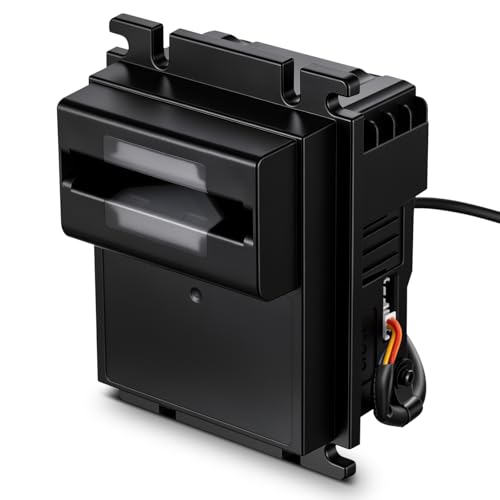
The Pulse Validator claims a compact form factor with omnidirectional insertion and universal embedded compatibility. It supports US denominations up to $100 and is designed to retrofit easily into a range of vending and kiosk platforms. Best for: space-constrained machines or upgrades to existing platforms needing multi-interface options. Why selected: its compact size and broad compatibility simplify front-end integration. Caution: verify exact platform compatibility with your control board before purchase.
Coinco BA30B Bill Validator Acceptor

The BA30B accepts $1 bills and is described as rebuilt with new belts and thoroughly checked. Best for budget-focused retrofits where only $1 acceptance is required. Why selected: simple, cost-effective option for machines needing basic bill validation. Caution: limited to $1 bills; plan for future expansion if higher denominations are anticipated.
MEI VN2512 Bill Validator Acceptor

MEI VN2512 supports 24-volt MDB or Serial interfaces and accepts $1 and $5 bills. It’s rebuilt with new belts for continued operation in mid-range machines. Best for: operators needing MDB or serial compatibility with reliable performance at an affordable retrofit level. Why selected: strong balance of compatibility and maintenance-friendly design. Caution: available features are focused on smaller denomination sets; plan for higher-denomination needs if required.
ITL BV30 Bill Acceptor Validator

ITL BV30 is touted as the most compact bill acceptor available, ideal for low-value transactions in beverage and snack vending. It features enhanced sensing and RGB bezel lighting for visibility. Best for: compact machines or entries where space and cost optimization are priorities. Why selected: small footprint and value-focused design. Caution: primary emphasis on low-value transactions; assess performance with expected bill mix.
Buying Guide
Key considerations help ensure you select the right bill validator for your vending setup.
What denominations should you support? If your location handles higher-value bills regularly, pick validators offering $20, $50, and $100 support in addition to $1 and $5. For many machines, supporting up to $20 or $50 covers typical transactions without overcomplicating the hardware.
Which interface fits your system? MDB, Serial, or USB compatibility determines upgradeability. A universal embedded design can simplify retrofits across multiple platforms. Check your vending controller’s supported interfaces before buying.
How important is compact size? Space-constrained machines benefit from a smaller validator like the BV30. For new builds with room to spare, larger validators with full banknote support can reduce future upgrade needs.
What about maintenance and parts? Rebuilt belts and readily available cleaning options help keep acceptance rates high. Consider models with easy access to belts and sensors, and look for established cleaning card ecosystems for ongoing maintenance.
Is retrofit compatibility a priority? If upgrading legacy machines, prioritize validators designed to replace older heads with minimal wiring changes. Universal compatibility reduces installation time and risk.
What reliability and security features matter? Enhanced sensing, anti-fraud measures, and robust bezel illumination improve user experience and reduce misreads or jams. Balance security features with maintenance access needs.
FAQ
- What is the main difference between these validators for vending machines?
– The primary differences are supported denominations, interface compatibility, mounting footprint, and upgrade readiness. Some models emphasize full banknote support, others prioritize compact size and retrofits. - Can I mix validators from different brands in the same machine?
– Mixing is generally not recommended. Verify controller compatibility and ensure consistent denomination handling to avoid reconciliation issues. - What should I consider for high-traffic locations?
– Choose validators with wide denomination support and robust sensing to minimize jams and slowdowns, plus easy maintenance to handle frequent use. - Are rebuilt validators reliable for commercial use?
– Rebuilt units can be cost-effective but require careful sourcing. Favor models with accessible belts and documented maintenance paths. - Is Omnidirectional insertion beneficial for all machines?
– It improves user experience in kiosks and front-facing vending setups, but verify that the machine frame can accommodate the sensor placement and routing. - How do I plan for future needs?
– Select validators with upgrade paths, universal compatibility, and flexible denomination support to reduce future replacement needs.