Best Motherboard Options for Threadripper CPUs
Threadripper platforms demand robust power delivery, expansive PCIe lanes, and ample cooling. This guide highlights five motherboards that best align with high-core-count AMD Threadripper workflows, from the latest sTR5/TRX50 boards to proven TRX40 and TR4 options. Each selection balances VRM design, memory capacity, expansion options, and compatibility to help enthusiasts choose a lasting platform for demanding workloads and creative tasks.
| Product | Socket / Chipset | Highlights |
|---|---|---|
| GIGABYTE TRX50 AERO D | AMD sTR5 | DDR5, PCIe 5.0, USB4 Type-C, Wi‑Fi 7, 10GbE |
| MB ASRock AMD TRX50 Threadripper | TRX50 | Threadripper PRO 7000 Ready, modern VRM basics |
| ASUS ROG Zenith II Extreme Alpha | TRX40 | 16 Infineon power stages, PCIe 4.0, Wi-Fi 6 |
| ASRock X399 TAICHI | TR4 | TR4 compatibility, strong audio, broad I/O |
| ASUS ROG Strix B550-F Gaming WiFi II | AM4 | PCIe 4.0, Wi‑Fi 6E, robust networking |
Choosing a Threadripper motherboard hinges on four core factors: socket compatibility, VRM strength, PCIe lane availability, and cooling options. For Threadripper’s multi-numeric workloads, prioritize boards with high-phase VRMs, robust heatsinks, and ample PCIe slots for GPUs, storage, and accelerators. Memory support matters too—AMD Threadripper platforms benefit from fast memory with ample capacity. Finally, consider software features such as BIOS customization, error reporting, and power regulation tools that help sustain long, intensive compute sessions. The products listed here provide a spectrum from cutting-edge to established TRX platforms, helping you tailor your build to your workload and budget.
GIGABYTE TRX50 AERO D Review

The GIGABYTE TRX50 AERO D is designed for AMD sTR5 (Threadripper PRO 7000 series) processors. Its power design features a 16+8+4 phase digital VRM solution, providing ample headroom for sustained workloads and overclocking scenarios common in professional rendering and simulation tasks. The board supports DDR5 memory in a 4-SMD R-DIMM configuration, with both AMD Expo and Intel XMP memory profiles, allowing users to optimize memory performance quickly. PCIe 5.0 readiness and PCIe 5.0 M.2 slots expand storage opportunities, while USB4 Type-C and Wi‑Fi 7 provide modern peripherals and high-speed connectivity. The Marvell 10GbE networking adds robust, low-latency data transfer suitable for content creation pipelines and server-class tasks. Fans and cooling zones are well considered, helping maintain thermal stability during long sessions. For Threadripper builds prioritizing next-gen storage and networking, this motherboard offers a forward-looking package with strong VRM engineering.
MB ASRock AMD TRX50 Threadripper

The ASRock AMD TRX50 Threadripper board targets the same high-end Threadripper audience with a focus on reliability and a balanced feature set. While product details emphasize motherboard naming and compatibility, the board is positioned to support Threadripper PRO 7000-class processors within a modern TRX50 ecosystem. Expect essential features like robust power delivery and essential PCIe expansion options. This board suits users who want a TRX50-capable platform with straightforward configuration and dependable performance for workstation tasks, 3D rendering, and content creation that benefit from the Threadripper architecture.
ASUS ROG Zenith II Extreme Alpha TRX40
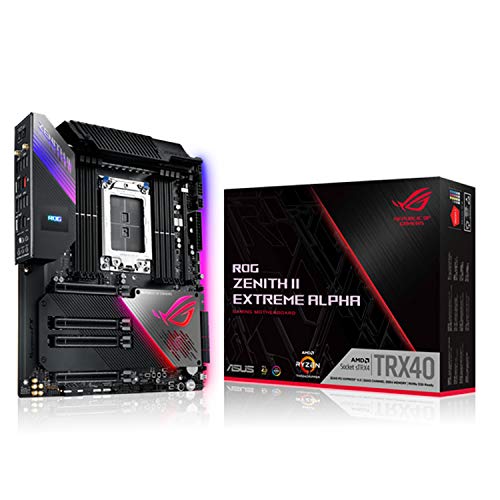
The ASUS ROG Zenith II Extreme Alpha is a flagship TRX40 motherboard designed for 3rd Gen Ryzen Threadripper processors. Its power delivery comprises 16 Infineon power stages, ProCool II connectors, microfine alloy chokes, and a robust set of capacitors, delivering strong stability under heavy computational loads. The board features comprehensive cooling design for the VRM, PCIe-zone M.2 aluminum heatsinks, and a backplate, complemented by a Fan Extension Card II and a water-cooling zone, enabling advanced cooling setups for sustained rendering or encoding workloads. PCIe 4.0 support and Wi-Fi 6 provide ample bandwidth and wireless connectivity for high-performance desktops and workstations.
ASRock X399 TAICHI

The ASRock X399 TAICHI targets the TR4 socket family and supports Ryzen Threadripper Series CPUs, bringing a long-standing TR4-era platform into the conversation. It features IR Digital PWM, an 11-phase system with Dr. MOS, and broad legacy and modern I/O capabilities. The motherboard is known for strong audio performance via codecs and DTS Connect compatibility, along with support for high-speed wireless connections. While not the newest platform, it offers a reliable, mature option for Threadripper users who value established compatibility and a proven feature set, especially for workstation builds that rely on legacy ecosystem stability.
ASUS ROG Strix B550-F Gaming WiFi II

Although not a Threadripper-specific board, the ASUS ROG Strix B550-F Gaming WiFi II offers robust PCIe 4.0 support, dual M.2 slots, USB 3.2 Gen 2 Type-C, HDMI 2.1, and DisplayPort 1.2. It includes onboard WiFi 6E and Intel 2.5 Gb Ethernet with ASUS LANGuard for reliable networking. This option serves as a more cost-conscious, mainstream alternative for users who want a high-performance platform with modern connectivity while still prioritizing stable power delivery and a competent feature set for Ryzen-based builds. It’s a practical choice when Threadripper-level expansion is not required but strong support for AMD Ryzen environments is desired.
Buying Guide: Key Purchase Considerations For Threadripper Platforms
- Socket and chipset compatibility: Threadripper generations vary by socket (sTR5/TRX50, TRX40, TR4). Confirm processor support and BIOS availability for your intended CPU family before purchasing.
- Power delivery (VRM): High-core-count Threadrippers demand robust VRMs. Look for high-phase designs, solid cooling solutions, and quality chokes and capacitors to sustain heavy workloads without throttling.
- PCIe bandwidth and slots: Ensure adequate PCIe lanes for GPUs, accelerators, and NVMe drives. PCIe 5.0 or 4.0 readiness is helpful for future-proofing, particularly on newer TRX50 boards.
- Memory support: Check memory type (DDR4 vs DDR5) and capacity limits. ECC support can be a consideration for workstation tasks; verify compatibility with Threadripper memory profiles (AMD Expo/XMP).
- Connectivity: Integrated Wi‑Fi, 2.5 GbE or 10 GbE, USB4, and high-speed USB ports improve overall system responsiveness in professional pipelines and file transfers.
- Cooling and thermals: Look for active VRM heatsinks, multiple fan headers, and space for large air coolers or water-cooling loops to manage thermal output during long compute runs.
- BIOS and software: A user-friendly BIOS with clear voltage controls, voltage offsets, and well-documented profiles helps optimize stability. Consider vendor support for BIOS updates and feature sets like BIOS Flashback.
- Future-proofing: If you plan to upgrade CPUs or add GPUs later, favor boards with additional PCIe slots, M.2 slots, and robust power design so your system remains capable over time.
- Form factor and expansion: For workstation builds, ensure the board size fits your chassis and that spacing allows for adequate airflow and cable management.
These considerations help align a motherboard choice with Threadripper workloads, whether you’re building a high-end workstation for 3D rendering, video editing, scientific computing, or virtualization. Balance the budget against the desired PCIe lanes, memory capacity, and cooling strategy to arrive at a platform that remains relevant as your tasks evolve.