Best Potting Epoxy for Electronics: Top Picks for Protection and Durability
Answering buyers looking for reliable epoxy potting solutions for electronics, these picks cover a range of applications from circuit-board coating to power-supply protection. Best for hobbyists and professionals needing robust insulation and moisture resistance, these products balance work life, cure profiles, and material compatibility. This guide highlights five strong options and explains who benefits most from each.
Summary table of selected products:
| Product | Brand | Best For | Key Benefit |
|---|---|---|---|
| WANJAO Electronic Potting Compound | WANJAO | Power supplies and PCBs needing thermal conductivity | Strong adhesion with thermally conductive properties |
| Epoxyseal 9000 Electronic Grade Potting Epoxy | Clearcast 7000 | Precision PCBs requiring high gloss and moisture resistance | High chemical and moisture resistance with clear finish |
| WANJAO Conformal Coating for Electronics | WANJAO | Component-level insulation and moisture barrier | High-density insulating barrier with good coverage |
| Electronic Potting Compound, 2-Part Epoxy, 25ml | multicomp PRO | Small projects and quick potting tasks | Convenient 1:1 mix with strong mechanical performance |
| 3M Scotch-Weld Epoxy Potting Compound DP270 | 3M | Low-viscosity, easy dispensing for tight spaces | Low shrinkage and non-corrosive to copper |
WANJAO Electronic Potting Compound

Product name: WANJAO Electronic Potting Compound, Thermally Conductive Epoxy Thermal Adhesive Insulation Waterproof Sealant for Electronic Component Packaging Led Power Supply Circuit Board Protection, 480g A+B. Features include insulation and waterproofing, a 5:1 AB mix ratio, and strong adhesion to various materials. Best for protecting power supplies and PCB assemblies where heat dissipation is beneficial. Limitation: cure time can extend to about 24 hours for full cure. This option suits users needing a robust, thermally conductive encapsulant with reliable sealing.
Epoxyseal 9000 Electronic Grade Potting Epoxy

Product name: Epoxyseal 9000 Electronic Grade Potting Epoxy, Epoxy Resin PCB Coating, Electronic Potting Epoxy, Casting Epoxy – 48oz KIT. Features include Rohs and Reach compliance, a 2:1 mix ratio, and a high-gloss finish with chemical and moisture resistance. Best for precision PCBs and electronic assemblies that require a durable, clear, and chemical-resistant protective layer. Caution: kit details emphasize a rigid cure; use where rigid encapsulation is appropriate.
WANJAO Conformal Coating For Electronics

Product name: WANJAO Conformal Coating for Electronics, Electrical Potting Compound Epoxy Resin for Circuit Boards. Benefits include insulation, moisture isolation, and a low-viscosity formula that fills gaps and reduces bubbles. Best for protecting control boards and sensors in humid environments. Limitation: designed as a conformal coating rather than a full potting pour; suitable for surface coating rather than bulk encapsulation.
Electronic Potting Compound, 2-Part Epoxy, 25ml

Product name: Electronic Potting Compound, 2-Part Epoxy, 25ml, Dual Syringe, Black. Features include a convenient 1A:1B mix ratio and low mixed viscosity, with extremely high compressive and tensile strength. Best for small-scale projects where a compact potting solution is needed. Limitation: smaller volume may limit large-volume applications.
3M Scotch-Weld Epoxy Potting Compound DP270

Product name: 3M Scotch-Weld Epoxy Potting Compound DP270, Black, 48.5mL Duo-Pak. Features include a 70-minute work life, low exotherm, and minimal shrinkage. Best for projects needing a longer potting window and reduced thermal stress. Limitation: black color may not suit all aesthetic or optical requirements; consider finish needs for visible coatings.
INNOVAYOU 200g Electronic Potting Compound
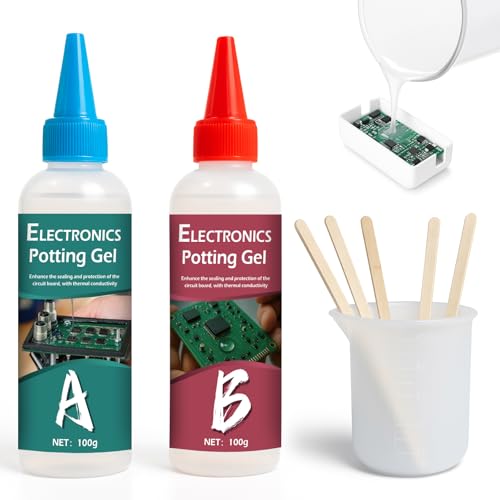
Product name: INNOVAYOU 200g Electronic Potting Compound, Moisture Proof Shock Clear Insulating Sealant. Benefits include dense moisture and dust isolation, good fluidity for gap filling, and 1:1 mix ratio. Best for DIY repairs and industrial packaging of circuit boards and LED lighting. Limitation: formulation may require careful mixing and surface prep to ensure the smooth finish described.
Buying Guide: How To Choose The Right Potting Epoxy For Electronics
What should you consider before buying a potting epoxy?
- Application type: Decide between full potting, surface conformal coating, or encapsulation. Full potting offers maximum protection but can affect heat dissipation; conformal coatings preserve board topology while protecting against moisture.
- Thermal conductivity: If heat generation is a concern, select epoxy with higher thermal conductivity to aid heat transfer away from critical components.
- Cure profile: Consider working life and cure time. Longer work life helps complex pours, while faster cures fit high-volume production.
- Adhesion and material compatibility: Ensure the epoxy adheres well to common substrate materials (PCB, copper, plastics) and withstands environmental conditions.
- Electrical properties: Check dielectric strength and insulation capabilities to prevent arcing and shorts.
- Volume and handling: Match product volume to project size; small syringes are convenient for repairs, while larger kits suit bulk encapsulation.
- Finish and appearance: Some epoxies cure clear or glossy; others are opaque. Choose based on visibility and aesthetics if the coating is exposed.
Frequently Asked Questions
- What is potting epoxy used for in electronics?
Potting epoxy provides insulation, moisture protection, and mechanical stabilization for delicate components, reducing vibration and moisture-related failures.
- How long does it take to cure potting epoxy?
Cure times vary by product, typically from several hours to 24 hours for full cure, with some formulations requiring longer under certain temperatures.
- Can potting epoxy be removed if needed?
Removability depends on the compound; many epoxies form strong bonds and are not easily removed, so plan for potential replacement or resealing.
- Is conformal coating the same as potting?
No. Conformal coating protects components on a board surface, while potting encapsulates the entire assembly or a broader area for enhanced protection.
- Which factors influence thermal performance?
Thermal conductivity, cure state, and the coating thickness all affect how well heat is moved away from components.