Best Router for a 3000 Sq Ft House: High-Performance WiFi Solutions
For large homes, a robust WiFi setup matters as much as the router you choose. This article highlights top WiFi 7 and WiFi 6 options designed to cover up to 3,000 square feet, support many devices, and deliver reliable gaming, streaming, and video conferencing performance. The selections emphasize mesh and single-router systems that balance speed, coverage, and security for American households with demanding internet needs.
| Product | Brand | Coverage | Notes |
|---|---|---|---|
| NETGEAR Nighthawk Tri-Band WiFi 7 RS500 | NETGEAR | Up to 3,000 sq ft | Router only, 12 Gbps potential |
| NETGEAR Nighthawk WiFi 7 BE9300 | NETGEAR | Up to 2,500 sq ft | Router only, strong tri-band |
| TP-Link Tri-Band BE9700 Archer BE600 | TP-Link | Up to 2,600 sq ft | 10G/2.5G ports, VPN, HomeShield |
| NETGEAR Nighthawk Advanced Whole Home MK72 | NETGEAR | Up to 3,000 sq ft | Mesh system with 1 satellite |
| ASUS ZenWiFi BT10 Tri-Band | ASUS | Up to 3,000 sq ft | WiFi 7, AIMesh, security features |
NETGEAR Nighthawk Tri-Band RS500

The RS500 model targets high-speed WiFi 7 performance with simulated real-time responsiveness across devices. It is designed for households requiring substantial bandwidth for gaming, 4K/8K streaming, and immersive video conferencing without the typical slowdowns seen in crowded environments. Note that this is a router-only unit; a separate cable modem is required for internet service. Its strengths lie in raw throughput and low-latency gaming experiences, particularly in homes with many competing devices. For larger homes, ensure optimal placement and consider a compatible mesh setup if your distance to dead zones is persistent.
NETGEAR Nighthawk BE9300 WiFi 7 Router

The BE9300 is a tri-band WiFi 7 router intended for gaming and entertainment with speeds up to 9.3 Gbps. Its design supports many devices and provides robust coverage for homes up to about 2,500 square feet per unit. As with other routers in the Nighthawk line, it pairs well with fiber and cable services that offer multi-gig speeds. If your home spans multi-story layouts or has several thick walls, pairing this router with a mesh system or additional access points can help maintain consistent coverage across rooms and outdoor spaces.
TP-Link Tri-Band BE9700 Archer BE600

The BE9700 Archer BE600 is built to prioritize performance using the latest WiFi 7 capabilities, including Multi-Link Operation and wide channel bandwidth. It features a 6 GHz/5 GHz/2.4 GHz tri-band setup, delivering high throughput for devices like new laptops, gaming consoles, and streaming devices. Coverage extends to about 2,600 square feet per unit with static or mesh configurations. Users should consider the placement and potential need for an additional node for edge-to-edge coverage in very large homes or multi-story layouts.
NETGEAR Nighthawk Advanced Whole Home MK72
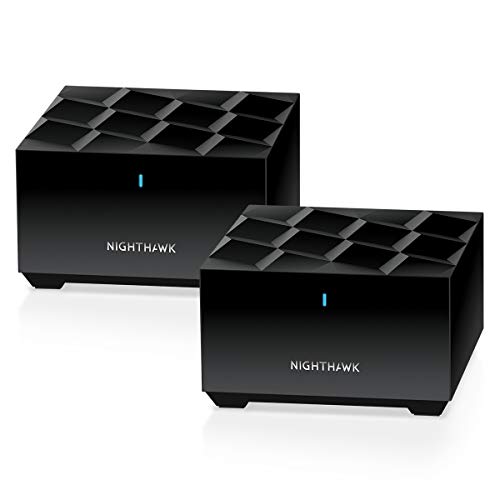
The MK72 mesh system pairs a main router with a satellite extender to blanket up to 3,000 square feet. It is designed for households with multiple users streaming, gaming, and conferencing across several rooms. The AX3000 standard provides solid performance for a blended home setup that may rely on several smart devices, cameras, and work-from-home configurations. Mesh configurations can minimize dead zones on multi-level homes, though placement remains critical for optimal backhaul performance and network stability.
Reyee AX3000 Wi-Fi 6 Router RG-E4

The Reyee RG-E4 delivers AX3000 Wi-Fi 6 performance with strong signal penetration due to multiple antennas. Coverage reaches up to 3,000 square feet, and the router supports up to 128 devices, making it suitable for busy households with many smart devices, cameras, and gaming systems. Gaming traffic prioritization helps optimize latency for online play. While not the latest WiFi 7, it provides excellent value in steady, reliable performance and broad compatibility with a wide range of internet plans.
Google WiFi AC1200 Mesh System

This dual-router mesh system provides coverage up to 3,000 square feet with a two-pack setup, designed to work together to deliver broad wireless coverage across large homes. While the latest features may be based on newer standards, the Google WiFi mesh approach remains a practical, user-friendly option for streaming, video calls, and general browsing. It scales well with additional units, though achieving optimal consistency may depend on network layout and interference from neighboring networks.
TP-Link Deco BE23 Dual-Band BE3600 Mesh

The Deco BE23BE3600 offers WiFi 7 capabilities with Multi-Link Operation and 4K-QAM for improved throughput. Each unit provides 2.5 Gbps wired ports for strong wired backhaul and a sizable mesh footprint suitable for medium-to-large homes. A key selling point is the ability to easily expand coverage by adding units, while HomeShield provides network security features, making it appealing for households seeking a balance of performance and protection across many devices.
ASUS ZenWiFi BT10 Tri-Band Mesh

The ASUS ZenWiFi BT10 emphasizes broad coverage with tri-band WiFi 7, 6 GHz support, and AIMesh for dynamic network optimization. It includes strong security and parental controls, helping families balance bandwidth with safety. The system is suitable for homes with multiple users who demand stable gaming, streaming, and smart-home device performance across several rooms and floors. As with other mesh systems, proper placement is crucial to minimize dead zones and maximize backhaul efficiency.
Buying Guide
- Coverage vs. speed: For 3,000 sq ft homes, prioritize devices that support multi-unit mesh setups or high-throughput single routers. WiFi 7 can offer future-proof performance, but ensure your internet plan and devices can take advantage of the speed.
- Router vs. mesh: If you have many walls or multi-story layouts, mesh systems typically reduce dead zones more effectively than a single router. Consider a 2-pack or 3-pack mesh if you have more than one living level.
- Wired backhaul: Look for 2.5G or 10G ports on nodes or routers to enable wired backhaul, which stabilizes performance for demanding tasks like 4K/8K streaming and competitive gaming.
- Security features: Built-in VPN support, firewall protections, and parental controls (HomeShield, AiProtection, etc.) help manage usage and protect devices on a large home network.
- Device compatibility and future-proofing: WiFi 7 is the latest standard, but ensure your devices can benefit from the upgrade and that the router supports features your devices use, such as MU-MIMO and OFDMA.
- Ease of setup and management: User-friendly apps, guest networks, and remote management simplify daily use, especially for households with multiple users and devices.
- ISP compatibility: Confirm that the router you choose works with your service provider, especially if you rely on a cable modem or fiber gateway. A separate modem is often required for many plans.
- Power and heat: Higher-speed models can generate more heat. Ensure adequate ventilation and avoid stacking routers in enclosed spaces.