Best Inspection Cameras for Plumbing: Durable, Flexible Borescopes for Tight Spaces
Find the right inspection camera for plumbing quickly. This guide highlights five reliable options ideal for plumbers, DIY homeowners, and HVAC technicians dealing with pipes, drains, and hard-to-reach areas. Each pick balances image clarity, cable flexibility, and waterproofing to help you identify leaks, cracks, and buildup without guesswork. The top picks emphasize different strengths: dual‑lens versatility, long-reach semi-rigid cables, and easy direct-display operation for fast diagnostics. Below is a quick product comparison to help you decide who benefits most from each tool.
| Product | Best For |
|---|---|
| Endoscope Camera with Light: 5″ 1080P Dual-Lens | Professional plumbers needing dual views in tight spaces |
| 50FT Endoscope Camera with Light | Long, accessible pipe runs and challenging interiors |
| Endoscope Camera with Light, 1920P | High-resolution imaging in hard-to-reach spots |
| Daxiongmao Endoscope Camera with Light | Simple, all‑around use with no phone connection |
| Teslong Two-Way Articulating Borescope | Complex spaces needing flexible maneuvering |
Endoscope Camera With Light: Dual-Lens 5″ Screen

This 5-inch HD endoscope features a 170° wide-angle view and a dual-lens system for front and side perspectives. It records live visuals on a 4.3-inch display and uses eight LEDs for illumination. The device is IP67 waterproof with a 16.4-foot semi-rigid probe, making it suitable for sewer and drain inspections, as well as automotive and HVAC tasks. Note: It cannot capture photos or videos, limiting documentation in the field.
- Best for: Plumbers who value quick, real-time visualization with dual perspectives.
- Limitation: No photo/video capture capability.
50FT Endoscope Camera With Light
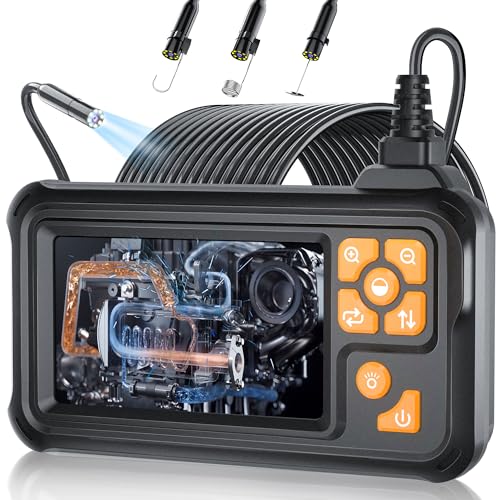
This 50-foot semi-rigid snake camera provides extended reach for long pipes and complex interiors. It features IP67 waterproofing, eight adjustable LEDs, and a 4.3-inch IPS display. The camera’s longer cable supports better access to distant obstructions, though operation time may be limited by battery life on the built-in 2000 mAh pack.
- Best for: Pros and serious DIYers needing to inspect longer runs and deeper spaces.
- Limitation: Short operational runtime on a single charge.
Endoscope Camera With Light, 1920P HD Borescope

This Kinpthy endoscope delivers 1920P clarity on a 4.3-inch display with a 16.4-foot semi-rigid probe and IP67 waterproofing. The device supports easy IOS/Android connectivity via app and offers a 2.0MP sensor for sharper stills and video near close-range focus. It does not require phone pairing, depending on usage, and supports direct monitoring on its built-in screen.
- Best for: Users who want high-resolution imagery and straightforward smartphone app pairing.
- Limitation: The device emphasizes display-based viewing over long recording runs.
Daxiongmao Endoscope With Light, 1080P

Equipped with a 4.3-inch LCD and IP67 waterproofing, this model uses an 8-LED lighting array for clear images in dark areas. Its 16.5-foot semi-rigid cable balances stiffness and flexibility for plumbing and wall inspections. Notably, it cannot capture photos or videos, focusing on live viewing for immediate diagnostics.
- Best for: Quick, hands-on inspections where you want immediate viewing without phone connections.
- Limitation: No photo/video capture capability.
Teslong Two-Way Articulating Borescope

This Teslong model uses a five-foot flexible, two-way articulating probe to reach tight corners and bends. It features a 4.5-inch IPS LCD color screen for clear visuals with no app required. The semi-rigid gooseneck helps retain cable shape for precise navigation. It’s well-suited for automotive maintenance and household plumbing inspections, especially where space is restricted.
- Best for: Inspections requiring rapid orientation in complex spaces without app dependencies.
- Limitation: Shorter probe length than some long-reach models.
Buying Guide
What to consider when choosing a plumbing inspection camera
Key factors include display quality, cable length and rigidity, lighting, and waterproofing. Longer, semi-rigid cables help access deep pipes, while IP67-rated probes withstand wet environments. A dual-lens or articulating tip improves view angles in obstructed spaces, but some units restrict recording or rely on live viewing only.
Display and recording capabilities
Decide between built‑in screens and smartphone connectivity. Built-in displays simplify field use and prevent phone contamination, but some cameras lack photo/video capture. If documentation matters, prioritize models with recording capabilities or easy capture options via apps.
Cable length and maneuverability
Longer cables extend reach but add weight and handling complexity. Semi-rigid cables strike a balance between flexibility and shape retention, ideal for plumbing runs, walls, and HVAC ducts. Consider the typical pipe sizes you inspect when selecting length.
Lighting and image clarity
Eight to twelve LEDs are common and help illuminate dark interiors. A wide viewing angle (around 70–170 degrees) improves context in narrow spaces. Resolution options range from 1080P to 1920P; higher resolution yields crisper imagery but may reduce live responsiveness in some cheaper models.
Waterproofing and durability
IP67 or better ratings protect against immersion and dust ingress. For sewer and drain work, waterproofing is essential. A robust probe connection and reliable seals reduce failure in harsh environments.
Compatibility and ecosystem
Some cameras pair with iOS or Android apps for photo/video and sharing. If you rely on device-independent viewing, choose models with stand-alone displays. If you prefer a broader toolbox, look for models with accessory options and compatibility notes.
Frequently Asked Questions
- Do all inspection cameras take pictures or video? Some models only support live viewing on built-in screens and do not record, while others offer photo/video capture via apps or internal storage.
- What’s a good cable length for plumbing work? For typical home plumbing, 15–30 feet covers most runs; 50 feet helps with longer or more complex installations, but may be heavier to maneuver.
- Is IP67 waterproofing enough for sewer use? IP67 is generally sufficient for wet environments. For continuous submersion, verify depth and duration ratings from the manufacturer.
- What if I need dual views? Dual-lens or two-axis cameras provide front and side views, improving detection of cracks, buildup, and misalignments in pipes.
- Can these cameras work with smartphones? Many models offer app-based viewing; some rely on built-in displays. Check compatibility with your device’s OS and version.
- Which camera is best for tiny spaces? Models with small-diameter probes (around 8–9 mm) and flexible, articulated tips perform best in tight bends and corners.